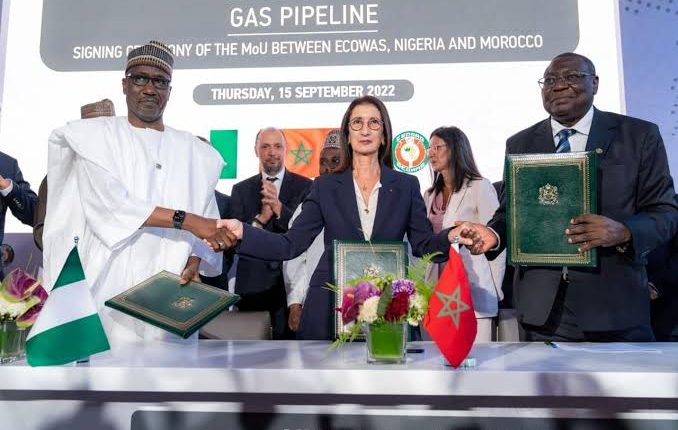
The Nigerian government, along with the Economic Community of West African States (ECOWAS), Morocco, and Mauritania, reaffirms its commitment to advancing the $26 billion African Atlantic Gas Pipeline project.
This update comes from the ECOWAS Inter-Ministerial Meeting on the Nigeria-Morocco Gas Pipeline, where officials confirm they are collaborating with additional stakeholders to move the project forward. The meeting, held in Abuja on Monday, brings together ECOWAS Ministers of Hydrocarbons and Energy, as well as representatives from Morocco and Mauritania.
The project, which aims to connect at least 13 countries, seeks to drive economic growth and enhance energy cooperation across West Africa and beyond.
In his address, Mele Kyari, Group Chief Executive Officer of the Nigerian National Petroleum Company Limited (NNPC), highlights the significance of the decisions made during the meeting, stressing that they will shape the future of the African Atlantic Gas Pipeline. Kyari, represented by NNPC’s Executive Vice President for Gas, Power & New Energy, Olalekan Ogunleye, emphasizes the importance of the project positively impacting the regional economy and local communities.
Ogunleye states:
“Today, we make significant progress with the African Atlantic Gas Pipeline project, one of Africa’s most transformative initiatives. This project will connect 13 nations, fostering shared prosperity and development. The decisions made here will shape the future of the pipeline, ensuring it benefits both the economy and our people. We have completed the front-end engineering design, finished phase two of the study, and are advancing with environmental and social impact assessments, as well as land acquisition and resettlement. These milestones demonstrate our collective resolve to bring this project to fruition.”
Ogunleye also underscores the importance of regional collaboration, stating that NNPC is well-positioned to lead the project, leveraging its expertise in production, processing, transmission, and marketing.
Minister Ekpo Emphasizes the Project’s Transformative Potential
Nigeria’s Minister of State for Petroleum Resources (Gas), Ekperikpe Ekpo, speaks about the transformative potential of the pipeline for Africa’s energy landscape. He stresses the importance of the ongoing agreements, which hold the power to reshape the continent’s energy sector, strengthen economies, and improve livelihoods.
“These agreements represent a critical opportunity to advance hydrocarbon trade within ECOWAS, increase access to natural gas in West Africa, and expand Africa’s presence in the global gas market,” Ekpo says.
Morocco and ECOWAS Officials Express Optimism
In her remarks, Morocco’s Minister of Energy Transition and Sustainable Development, Laila Benali, expresses optimism about the project’s potential to open new markets and generate employment opportunities. ECOWAS Commissioner for Infrastructure, Energy, and Digitalisation, Sediko Douka, stresses the importance of continued collaboration, stating that this is a crucial phase in the project’s development and that all parties must work closely to ensure its success.
Key Project Details
The Nigeria-Morocco Gas Pipeline (NMGP) was first proposed during King Mohammed VI’s visit to Nigeria in December 2016. The African Atlantic Gas Pipeline (AAGP) includes two major components: the $975 million West African Gas Pipeline Extension Project, spanning 678 km, and the 5,669 km Nigeria-Morocco Gas Pipeline, expected to cost around $25 billion.
The AAGP will utilize Nigeria’s vast natural gas reserves, helping to diversify its gas export routes, reduce flaring, and boost national revenue. The pipeline will supply gas to Morocco, 13 ECOWAS countries, and ultimately Europe, fostering economic integration across the region. The pipeline will span 5,300 km from Nigeria to Dakhla in Morocco, with an additional 1,700 km of onshore pipeline extending from Dakhla to northern Morocco.