








By Boluwatife Oshadiya | March 4, 2026
Key Points
- Company Income Tax collections rose 6.55% quarter-on-quarter to ₦2.96 trillion in Q3 2025
- Foreign CIT payments accounted for ₦1.75 trillion, surpassing domestic collections of ₦1.21 trillion
- Manufacturing, mining, and financial services sectors led overall tax contributions
Main Story
Nigeria’s Company Income Tax (CIT) collections climbed to ₦2.96 trillion in the third quarter of 2025, marking a 6.55 percent increase from the ₦2.78 trillion recorded in the second quarter, according to official data.
The latest figures show that foreign companies contributed ₦1.75 trillion in CIT payments during the period, while domestic firms accounted for ₦1.21 trillion, underscoring the continued dominance of foreign-linked tax flows in federal revenue performance.
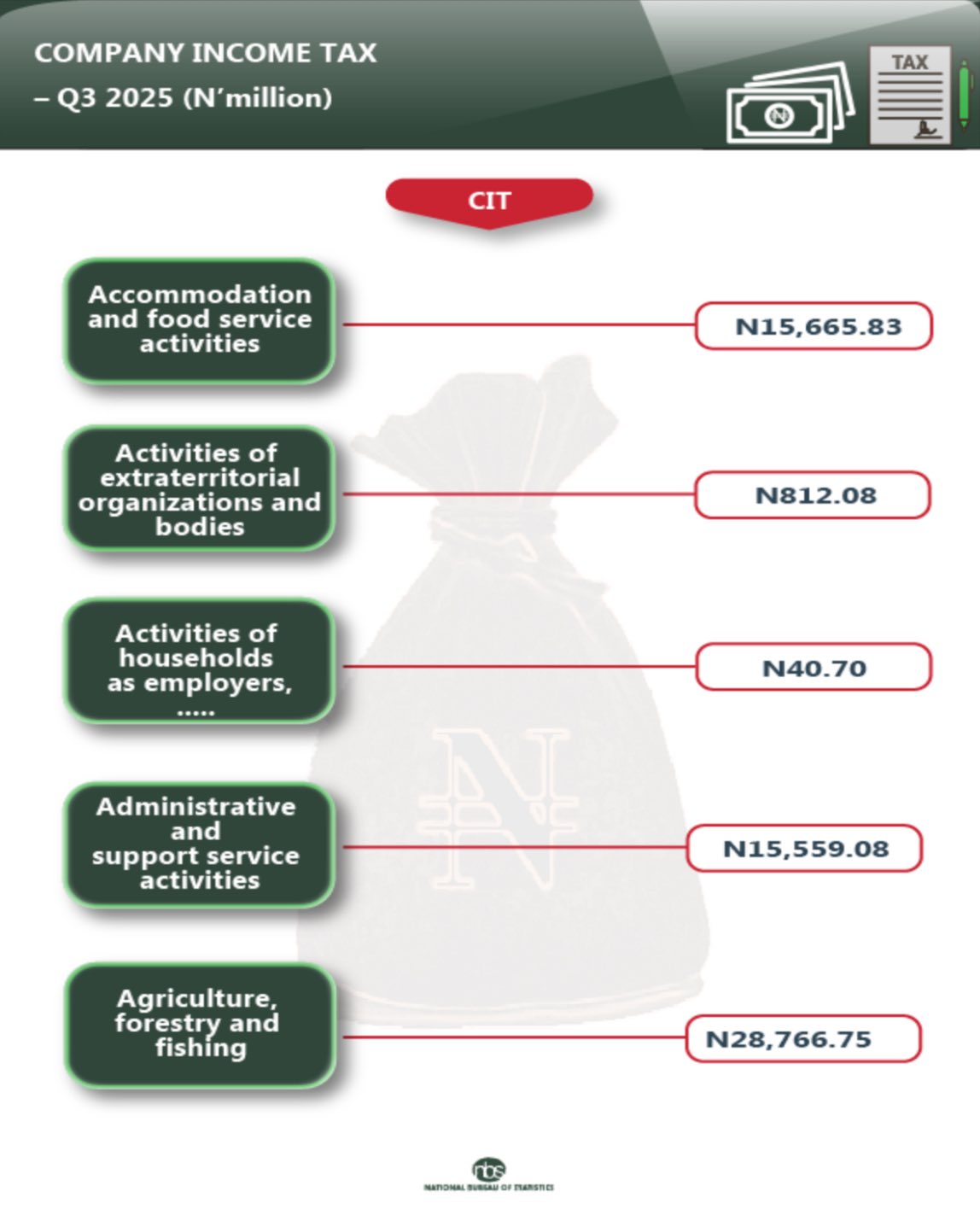
On a sectoral growth basis, Arts, entertainment and recreation activities recorded the strongest quarter-on-quarter expansion at 41.98 percent. Accommodation and food service activities followed with 37.11 percent growth, while Mining and quarrying expanded by 15.36 percent.
Conversely, Activities of households as employers and undifferentiated goods- and services-producing activities for own use posted the sharpest contraction at –83.88 percent. Financial and insurance activities declined by 79.72 percent quarter-on-quarter, while construction recorded a 66.52 percent drop.
In terms of contribution share, Manufacturing emerged as the largest contributor to CIT collections in Q3 2025, accounting for 22.43 percent of total revenue. Mining and quarrying followed with 20.24 percent, while Financial and insurance activities contributed 17.11 percent.
At the lower end of the contribution scale, Activities of households as employers and own-use production recorded just 0.003 percent of total CIT. Water supply, sewerage, waste management and remediation activities contributed 0.04 percent, while Activities of extraterritorial organisations and bodies accounted for 0.07 percent.
On a year-on-year basis, CIT collections surged by 67.19 percent compared to Q3 2024, indicating a significant expansion in corporate tax inflows over the 12-month period.
The Issues
The widening gap between foreign and domestic CIT contributions highlights Nigeria’s structural dependence on multinational and extractive-sector tax flows. With foreign payments accounting for nearly 60 percent of total CIT in Q3 2025, revenue performance remains sensitive to global commodity prices, exchange rate movements, and cross-border corporate earnings.
The strong performance of manufacturing and mining suggests resilience in real-sector activity, but the steep quarter-on-quarter declines in financial services and construction point to possible sectoral volatility. These shifts may reflect regulatory adjustments, base effects from previous quarters, or changing profit margins across industries.
The 67.19 percent year-on-year increase also raises analytical questions about inflationary impacts, exchange rate pass-through effects, and whether nominal revenue gains translate into real fiscal strengthening.
What’s Being Said
“The steady rise in Company Income Tax reflects improved compliance and stronger monitoring mechanisms across key sectors of the economy,” a senior official at the Federal Inland Revenue Service (FIRS) said in a statement accompanying the release.
“However, the dominance of foreign tax payments indicates that domestic enterprise growth must accelerate if Nigeria is to achieve more balanced and sustainable revenue expansion,” said Bismarck Rewane, Chief Executive Officer, Financial Derivatives Company.
“The contraction in financial and insurance sector contributions may signal temporary profitability adjustments rather than systemic weakness,” noted Ayodeji Ebo, Managing Director, Optimus by Afrinvest.
What’s Next
- The Federal Government is expected to review full-year 2025 tax performance figures in its upcoming fiscal update
- Analysts will monitor Q4 2025 data to determine whether sectoral contractions persist or reverse
- Ongoing tax reform measures and compliance enforcement strategies are likely to shape CIT trends into 2026
The Bottom Line: Nigeria’s ₦2.96 trillion Q3 2025 CIT performance signals strong nominal revenue growth, but the composition of that growth matters. Heavy reliance on foreign tax payments and extractive sectors means fiscal stability remains closely tied to external conditions rather than broad-based domestic expansion.










 collections climbed to ₦2.96 trillion in the third quarter of 2025, marking a 6.55 percent increase from the ₦2.78 trillion recorded in the second quarter, according to official data.)