

Key Points:
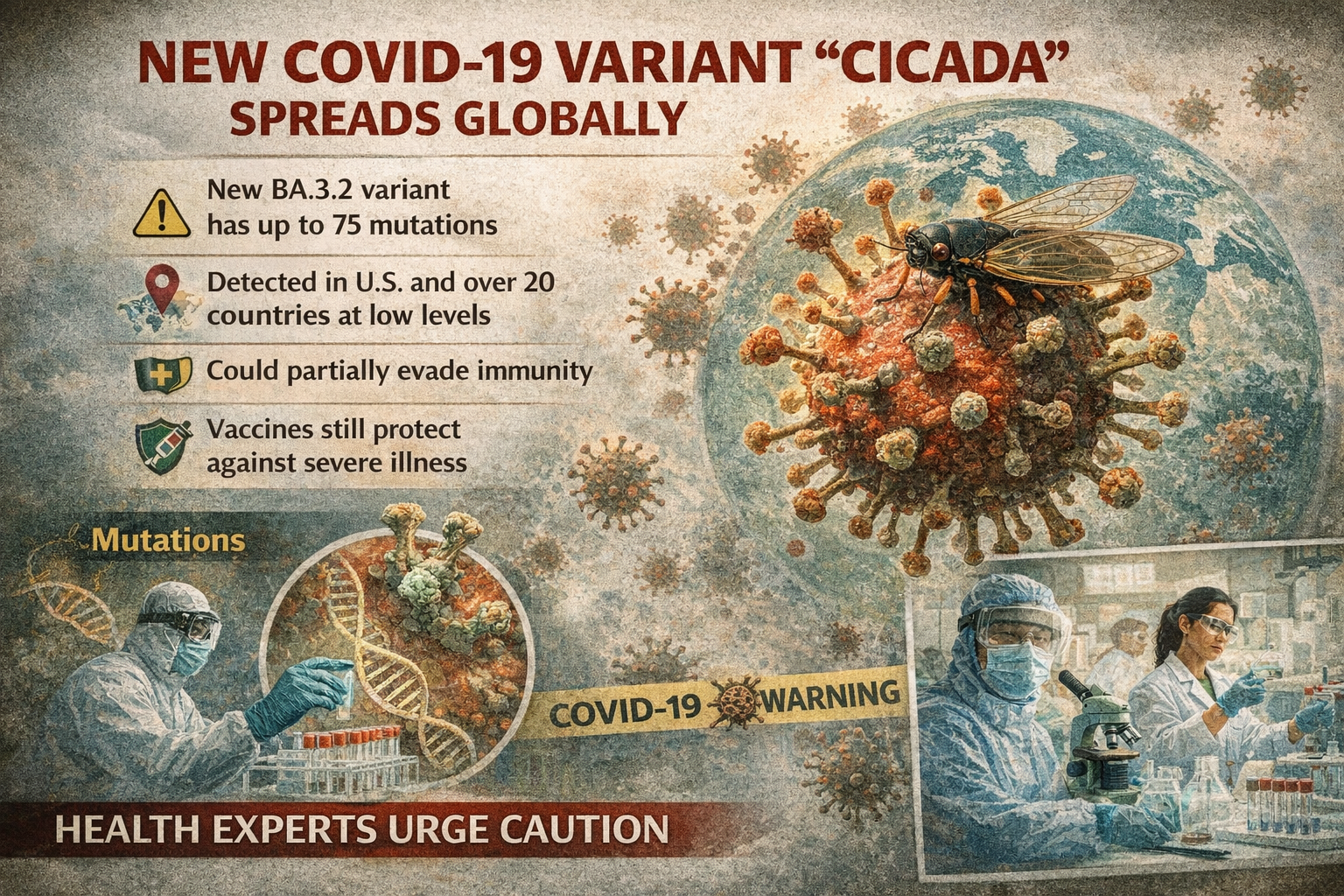
- New COVID-19 variant BA.3.2 has up to 75 mutations
- Detected in the U.S. and over 20 countries, but still at low levels
- Experts say it may evade immunity but is not yet a major threat
- Vaccines are still expected to protect against severe illness
Main Story:
A new COVID-19 variant known as BA.3.2 is raising concerns among health experts due to its unusually high number of mutations. The variant, sometimes called “Cicada,” has been detected in the United States and at least 22 other countries.
According to health reports, BA.3.2 carries between 70 and 75 mutations—far more than earlier variants like JN.1, which has been dominant in recent years. Scientists say this could make the virus more adaptable and harder for the immune system to recognize.
In the United States, the variant has been found in several samples, including travelers, patients, and wastewater testing across multiple states. However, its overall presence remains low, accounting for only about 0.19 percent of tested cases.
Despite its spread, experts say there is no immediate cause for panic. Current data shows that BA.3.2 is not yet spreading rapidly or causing more severe illness than other variants.
The Issues:
One major concern with BA.3.2 is its high number of mutations, especially in the spike protein. This is the part of the virus that helps it enter human cells and is also the main target of vaccines.
Because of these mutations, scientists worry that the variant may be better at avoiding immunity from past infections or vaccinations. This could make it easier for people to get infected again.
Another issue is the unpredictability of new variants. While BA.3.2 is currently under control, viruses can evolve quickly. A small change could increase its ability to spread or cause more serious illness.
In addition, global differences in vaccination rates and public health measures can affect how quickly a variant spreads from one region to another.
What’s Being Said:
Health experts are closely monitoring the situation. Dr. Andrew Pekosz, a virologist, said the variant is not an immediate threat but could become more concerning if it continues to evolve.
He explained that ongoing circulation increases the chances of the virus changing in ways that may make it more dangerous.
Dr. Robert Hopkins, another health expert, noted that while vaccines may not work as effectively against BA.3.2, they are still expected to protect against severe illness. He also said there is no clear evidence that the variant causes worse symptoms than other strains.
The World Health Organization has also stated that existing vaccines and treatments should still help prevent serious disease.
What’s Next:
Scientists will continue to track BA.3.2 through testing and global surveillance. More research is expected to determine how well vaccines and treatments work against it.
There is also a possibility that the variant could drive a future rise in COVID-19 cases, especially if it becomes more transmissible. However, experts say this is not certain.
Public health officials are encouraging people to stay updated with vaccinations and remain cautious, especially in crowded or high-risk environments.
Bottom Line:
The BA.3.2 “Cicada” variant is not a major threat right now, but its high number of mutations makes it one to watch. While vaccines still offer protection against severe illness, continued monitoring and public awareness will be key to preventing another surge.







%20spreads%20to%20over%2020%20countries%20with%20high%20mutations.%20Experts%20urge%20caution.)