








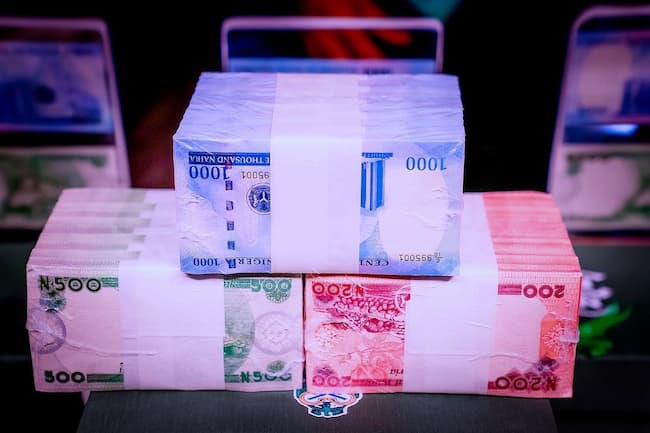
The naira weakened marginally in July, depreciating by approximately ₦3.85 at the official market, even as Nigeria’s external reserves rose by $2.15 billion during the same period.
According to the Central Bank of Nigeria (CBN) FX update, the naira closed at ₦1,533.33 per dollar at the Nigerian Foreign Exchange Market (NFEM) on Thursday, softening from ₦1,529.27 at the beginning of the month.
On Thursday, the local currency appreciated slightly from the previous day’s ₦1,534.52 as dollar demand eased. The intraday high was recorded at ₦1,535, compared to ₦1,537 on Wednesday, while the lowest traded rate stood at ₦1,533.
Despite the naira’s weakening, Nigeria’s gross external reserves surged by $2.15 billion, climbing to $39.36 billion as of July 30, up from $37.21 billion recorded at the end of June. Analysts attribute this growth to increased dollar inflows from Open Market Operations (OMO) and cautious forex market interventions by the CBN.
Market watchers note that the apex bank has significantly reduced its intervention in the FX market but continues to maintain a close watch to keep the exchange rate within its preferred band.
In a recent note, analysts at Verto FX observed that the CBN is testing the market with different OMO tenors, although short-term offerings have failed to attract strong foreign investor demand. “While annualised yields on primary OMO papers are above 24%, the three-month tenors are not drawing the expected foreign appetite. Investors seem more focused on 6-month to 1-year durations,” the note stated.
The expiration pace of existing OMOs is also expected to increase throughout 2025. Analysts anticipate that the CBN will issue new OMO bills to help investors roll over maturing positions and manage excess liquidity in the system.
However, this strategy is facing fresh scrutiny. Verto FX noted that money supply (M2) has begun to show modest growth, suggesting that some foreign investors may be converting naira proceeds back into dollars upon maturity of OMO investments, potentially increasing pressure on the exchange rate.
Despite these concerns, the naira has remained within a relatively stable range, supported by improved dollar supply and the CBN’s tactical interventions.