







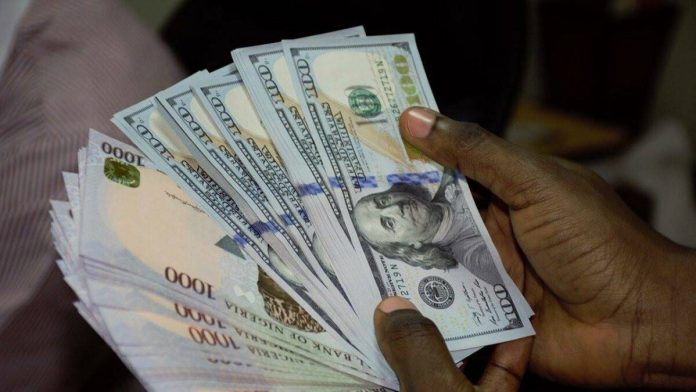
Nigeria’s currency, the naira, achieved a significant appreciation of around ₦54 against the U.S. dollar over the month of October, reflecting a favourable combination of offshore export flows and strengthening external reserves. At the end of October, the local rate in the Nigerian foreign-exchange market closed at approximately ₦1,421 per dollar—up from ₦1,475 per dollar at the end of September.
Analysts attribute the advance to a broad sell-off in the U.S. dollar index as global central banks embarked on further interest-rate reductions. Nigeria’s FX inflows from hydrocarbon exports also played a central role, supported by dollar-volume revenues from international oil companies and reduced fuel import payments. Additionally, foreign portfolio investors increased their wagers in treasury instruments, aiding the naira’s moderate appreciation. The exchange rate moved from about ₦1,465.29 per dollar at the start of the week to ₦1,457.96 by Friday, underscoring improved market dynamics and relatively restrained intervention by the Central Bank of Nigeria (CBN).
In October, Nigeria’s gross external reserves rose by approximately US$819 million, reaching US$43.172 billion from US$42.353 billion at the end of September. The rise in reserves provides increased stability in the FX market and supports a positive outlook for the naira in 2025, according to several analysts.
The global oil-market backdrop was nuanced. At the month’s start, the OPEC+ cartel signalled a planned output boost in December, raising near-term supply expectations even as demand remained weak—particularly in China, where industrial activity shrank for a seventh straight month. Geopolitical pressure, including the Israel–Hamas conflict and Western sanctions on Russian oil majors such as Rosneft and Lukoil, added short-lived volatility, but persistent Russian crude exports dampened hopes for major supply disruption. These factors, together with swelling inventories and slack demand, pushed Brent crude down by 5.2 % month-on-month to about US$64.50 per barrel.
Toward the week’s end, oil prices staged a modest rebound: Brent crude gained US$4.65 (up 7.59%) to close at US$65.94 per barrel, while U.S. West Texas Intermediate (WTI) added US$4.35 (up 7.61%) to finish at US$61.50 per barrel. Meanwhile, spot gold trimmed losses after U.S. inflation data came in slightly softer than expected—further raising expectations of an imminent rate cut by the Federal Reserve—even though the metal still ended the week lower, with spot gold down 3.24% to US$4,112.10 per ounce and U.S. futures settling at US$4,137.80.
Overall, Nigeria’s improved external-reserves position and stabilising FX trends suggest a firmer footing for the naira as the country moves into 2025.