







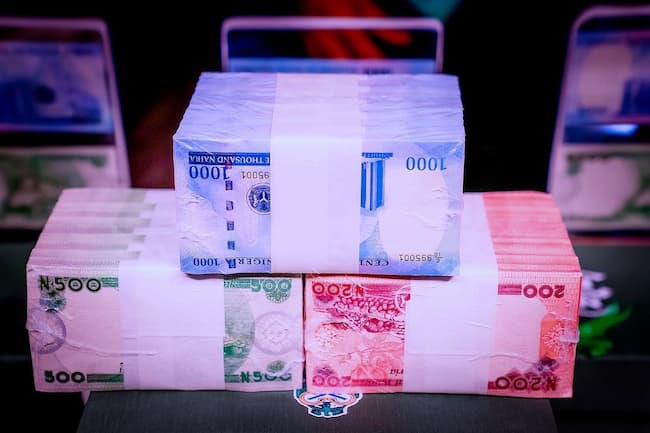
The Nigerian naira appreciated slightly against the U.S. dollar in the official market, buoyed by reduced demand pressures and improving investor confidence, while the country’s foreign reserves surpassed the $39 billion threshold for the first time in months.
According to the Central Bank of Nigeria (CBN), the official exchange rate strengthened to ₦1,533.18 per dollar on Tuesday, compared to ₦1,534.20 recorded a day earlier. Trading data also showed intraday fluctuations, with rates reaching a high of ₦1,535.50 and dipping to a low of ₦1,520, before settling at ₦1,532.50.
Analysts believe that the CBN’s direct intervention strategy is shielding the local currency from excessive volatility, further reinforced by the recovery in external reserves.
Latest data from the CBN indicates that Nigeria’s foreign reserves have risen above $39 billion — the highest since February 2025 — reversing the downward trend that followed $4.7 billion in forex interventions in the first half of the year which dragged reserves to around $37 billion.
However, the lack of detailed data on the origin of the recent inflows continues to obscure clarity on reserve dynamics, despite the positive trend observed throughout July.
In the parallel market, checks by MarketForces Africa showed that the naira exchanged at ₦1,532 to the dollar, essentially narrowing the gap between official and street rates and dampening speculative activity in the forex market.
Meanwhile, global markets remained on edge ahead of the Federal Reserve’s policy meeting. Brent crude oil rose to $70.41 per barrel, while U.S. West Texas Intermediate (WTI) advanced by $1.89 to trade at $67.05 per barrel, as markets responded to a fresh U.S.-EU trade agreement and President Trump’s ultimatum to Russia over the Ukraine conflict.
In contrast, gold prices dipped following the stronger dollar and renewed risk appetite, as traders awaited direction from the Fed’s monetary policy decision later this week.