









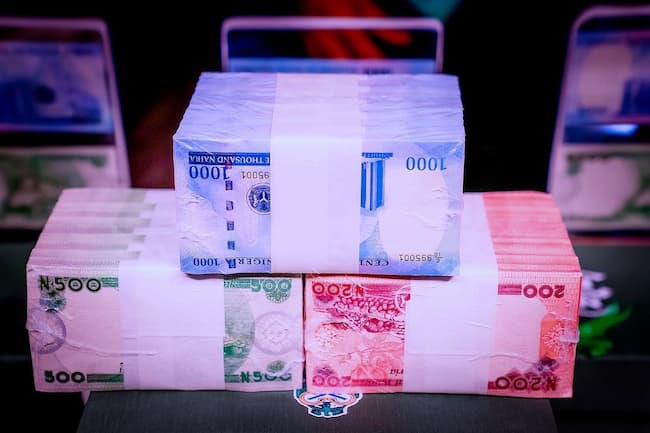
The Nigerian naira depreciated by approximately N3 per U.S. dollar at the Nigerian Foreign Exchange Market (NFEM), closing at N1,605.62 on Monday, down from N1,602.18 on Friday, data published by the Central Bank of Nigeria (CBN) has shown.
Conversely, the naira gained 1.25% in the parallel market, appreciating to N1,600 per dollar, as market participants looked ahead to the end of foreign exchange sales to Bureau De Change (BDC) operators, which the apex bank has scheduled to conclude in May.
The CBN refrained from intervening in the FX market to shore up liquidity, although market analysts maintain that ongoing participation by the regulatory authority will be critical to supporting the local currency.
According to AIICO Capital Limited, demand in the interbank FX market intensified, with the naira-dollar pair trading between N1,601.98 and N1,611.00 during the session. By close of trade, the naira had weakened by 22 basis points, ending the day at N1,605.6284. “CBN participation should maintain the naira within its existing trading range through the near term,” the investment firm noted in its market report.
The previous week saw the naira come under pressure following a 10% decline in FX inflows through the Nigerian Autonomous Foreign Exchange Market window. Total inflows dropped to $668 million, compared to $735 million the week prior.
Coronation Research reported that the Central Bank accounted for 27.73% of the total inflows. Foreign portfolio investors (FPIs) contributed 9.22%, while non-bank corporates supplied 33.43%. Exporters made up 24.34% of inflows, and the remaining 5.28% came from other sources.
Nigeria’s external reserves climbed back to $38 billion due to renewed accretion after experiencing a string of declines in April, amid ongoing uncertainty in the global commodities market. Oil prices dropped by over $1 per barrel on Monday following the announcement by OPEC+ of plans to accelerate output increases, stoking fears of a supply glut amid tepid demand projections.
Brent crude fell by $1.54, or 2.51%, to settle at $59.75 per barrel, while U.S. West Texas Intermediate (WTI) crude slid by $1.64, or 2.81%, to $56.61 per barrel.
In contrast, gold prices rose sharply—climbing more than 2%—as the weakening U.S. dollar and rising safe-haven demand boosted investor appetite ahead of a pivotal Federal Reserve policy decision later this week.
Spot gold jumped 2.2% to $3,312.09 per ounce, while U.S. gold futures advanced 2.4% to $3,321.30 per ounce, continuing the metal’s recent bullish trend.
Market analysts warned that crude oil prices may face continued downward pressure, citing a combination of uncertain demand due to trade tensions and fluctuating supply conditions driven by OPEC+ policy shifts.




, closing at N1,605.62 on...)