








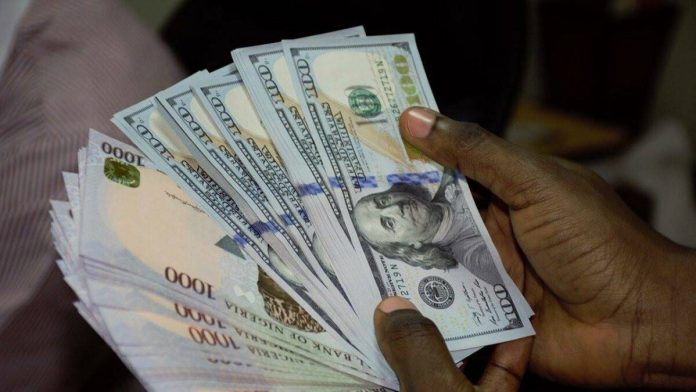
Nigeria’s naira traded largely flat on Tuesday at both official and parallel markets, as the Central Bank of Nigeria (CBN) emerged the dominant player in the foreign exchange (FX) space, accounting for over half of total dollar inflows.
Data from the Nigerian Foreign Exchange Market (NAFEM) shows that the naira closed at ₦1,602.63/$1, a marginal depreciation of 0.2% from ₦1,599.93 recorded last Thursday before the Easter holiday. Meanwhile, the parallel market remained unchanged at ₦1,610/$1, based on rates from street traders and online sources.
According to a report by Coronation Merchant Bank Research, FX inflows into NAFEM rose sharply to $1.42 billion this week from $847 million the previous week, with the CBN contributing 50.6% of the total. Other major contributors included non-bank corporates (25.14%), exporters (12.99%), and Foreign Portfolio Investors (FPIs), who accounted for just 8.61%.
Despite recent gains, forward contract rates suggest that market participants remain cautious. The one-month forward rate stood at ₦1,642.03/$1, while the three-month, six-month, and one-year forwards closed at ₦1,720.49/$1, ₦1,802.37/$1, and ₦1,979.27/$1 respectively.
The CBN’s January economic report revealed a 4.4% decline in net FX inflows, which dropped to $4.79 billion from $5.01 billion in December 2024. Total FX inflows also fell to $9.63 billion, while outflows dropped to $4.84 billion, indicating reduced activity in the apex bank’s FX operations.
CBN-sourced inflows dipped significantly to $2.33 billion in January from $4.09 billion the previous month, even as autonomous inflows rose to $7.31 billion, up from $6.08 billion. Conversely, outflows through the CBN declined to $3.80 billion, while autonomous outflows edged up slightly to $1.04 billion.
This shift resulted in a net outflow of $1.47 billion via the CBN, compared to just $0.07 billion in December. However, net inflows through autonomous channels increased to $6.26 billion—highlighting growing confidence and participation from non-CBN sources in the FX ecosystem.
Every month, the naira showed modest appreciation in January. The average exchange rate improved by 1.16% to ₦1,535.94/$1 from ₦1,553.73 in December, while the end-of-month rate strengthened by 3.90% to ₦1,478.22/$1.
Parallel market sentiment also improved slightly, with the naira gaining ₦5 to close at ₦1,605/$1 from ₦1,610/$1.
Despite the decline in inflows, Nigeria’s external reserves remained solid, closing January at $38.88 billion, down from $40.19 billion in December. As of April 16, reserves stood at $37.88 billion, according to latest CBN data—a weekly drop of 0.39%.
The current reserve level is enough to cover 8.82 months of imports of goods and services, or 13.2 months of goods alone, providing a critical buffer against external shocks.
Yuan Watch: Naira Slips
Against the Chinese Yuan (CNY), the naira depreciated by 0.44%, closing at ₦219.16/CNY.




 emerged ...)