








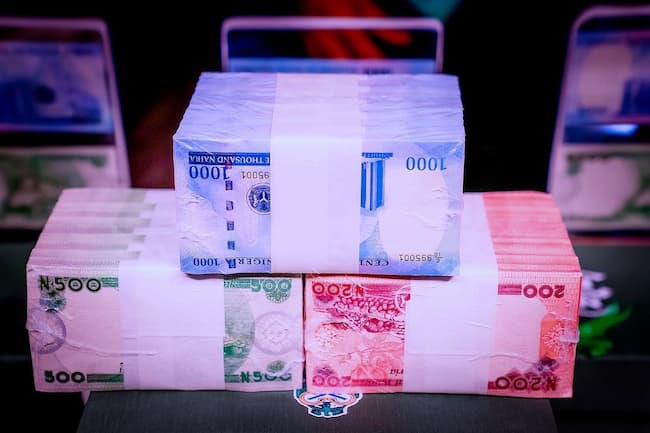
The Nigerian naira has weakened against the US dollar across different currency markets due to increased demand. The exchange rate fell to ₦1,536.15 in the official market, while the parallel market rate dropped to ₦1,580, according to data from the foreign exchange (FX) market.
This decline comes after recent gains by the naira, as foreign investors and debt repayment obligations increased the need for dollars. On Tuesday, the exchange rate was under pressure due to high demand, while the supply of dollars remained limited.
In the official market, the exchange rate fluctuated between ₦1,520 and ₦1,540 before settling at ₦1,536.15, according to AIICO Capital Limited. Data from FMDQ also revealed that total inflows into the FX market fell by 12.9%, dropping from $4.74 billion in January to $4.12 billion in February. This decline was caused by a broad reduction in foreign and local inflows, with the Central Bank of Nigeria (CBN) cutting its contribution by 36.3%.
Despite this, analysts expect the CBN to continue supporting the naira to aid recovery, even as the country’s foreign reserves decline. Nigeria’s foreign reserves have dropped to $38.35 billion due to global market uncertainties, putting pressure on oil export earnings.
Meanwhile, oil prices saw a slight increase on Tuesday as a weaker US dollar supported the market. However, concerns over a potential US economic slowdown and the impact of trade tariffs limited gains. Brent crude futures rose by 36 cents (0.5%) to $69.64 per barrel after hitting a session low of $68.63, while US West Texas Intermediate crude gained 28 cents (0.4%) to reach $66.31.
Gold prices also went up by 1% due to increased safe-haven demand amid economic uncertainty and a softer US dollar. Spot gold climbed to $2,919.29 per ounce, while US gold futures increased by 0.9% to $2,926.30. Investors are closely watching upcoming inflation data for insights into future interest rate changes.