

Keypoints
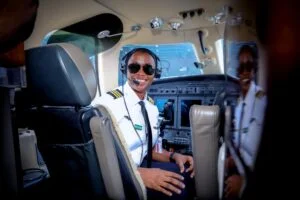
- Nafisat Balogun, a Superintendent of Customs, has officially secured her commercial multi-engine pilot licence in the United States.
- The achievement marks a historic milestone as she becomes the first female pilot in the history of the Nigeria Customs Service (NCS).
- Balogun’s career path is being hailed as “transformative,” having risen through the ranks from a cabin attendant to a fully licensed commercial pilot.
- The NCS Technical Hangar Service organized a ceremony to honor her, citing her success as a victory for gender inclusion within the service.
- Comptroller-General of Customs, Bashir Adeniyi, was commended for providing the leadership support necessary to break barriers in specialized fields.
Main Story
The Nigeria Customs Service (NCS) has officially entered a new era of aviation history with the successful licensing of its first female pilot.
Superintendent Nafisat Balogun returned from the United States this week after completing the rigorous requirements for a commercial multi-engine pilot licence. Her journey is particularly notable because she did not start in the cockpit; she began her aviation career as a cabin crew member, proving that internal growth and specialized training are top priorities for the service in 2026.
During a celebration at the Customs Technical Hangar, Captain Kuhi Mbaya noted that Balogun has effectively “shattered the glass ceiling” in a field traditionally dominated by men.
The NCS spokesperson, Abdullahi Maiwada, emphasized that this feat is not just a personal victory but a strategic win for the agency’s aerial surveillance and transport capabilities.
By investing in female aviators, the Customs Service is signaling a broader commitment to modernizing its operations and diversifying its expert personnel.
The Issues
The primary challenge is the “specialization-gap”; while the NCS has a strong fleet, it has historically lacked a diverse pipeline of locally trained pilots, often relying on a small pool of male officers.
Authorities must solve the problem of technical-retention, ensuring that highly trained assets like Balogun are given the advanced tools and flight hours needed to maintain their elite skills.
Furthermore, there is a cultural-barrier risk; specialized units in paramilitary organizations can sometimes be resistant to gender shifts, which is why the public endorsement from the Comptroller-General is critical for setting a new standard.
To succeed, the NCS must leverage Balogun’s success to launch a formal aviator-mentorship program that encourages more women to move from administrative or cabin roles into technical flight operations.
What’s Being Said
- “The glass ceiling has been shattered, and with determination… more women can achieve their dreams,” stated Captain Kuhi Mbaya, Managing Director of the Customs Technical Hangar Service.
- Nafisat Balogun thanked the service for “believing in her capacity,” vowing to serve with the highest levels of integrity and professionalism.
What’s Next
- Advanced flight assignments are expected for Superintendent Balogun as she integrates her new multi-engine skills into the NCS’s aerial border patrol operations.
- A recruitment drive focusing on female STEM graduates for the Customs aviation wing may be announced later in 2026 to build on this momentum.
- Training partnerships between the NCS and international flight schools are anticipated to expand, providing more officers with US-standard licensing opportunities.
- A documentary or profile series highlighting Balogun’s journey from cabin crew to pilot is likely to be released to boost the agency’s “employer brand” among Nigerian youth.
Bottom Line
Nafisat Balogun isn’t just flying planes; she’s flying the flag for a more inclusive Nigeria Customs Service. Her transition from cabin attendant to commercial pilot proves that with the right institutional support, the only limit for Nigerian women in 2026 is the sky.



%20has%20officially%20entered%20a%20new%20era%20of%20aviation%20history%20with%20the%20successful%20licensing%20of%20...)