









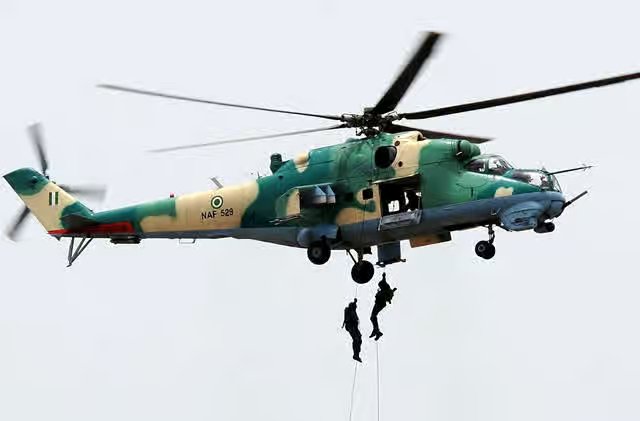
A coordinated military operation involving the Nigerian Air Force (NAF), the Beninese Armed Forces and French troops yesterday thwarted an attempted coup in the Republic of Benin, restoring a fragile calm to Cotonou after hours of tension and sporadic gunfire near the presidential residence.
The failed takeover; the latest in a region increasingly rattled by democratic backsliding, marks ECOWAS’ sixth major assault on civilian rule since 2020.
The Guardian gathered that two NAF fighter jets were deployed from Lagos at dawn after renegade soldiers broadcast an announcement claiming to have overthrown President Patrice Talon. French military aircraft were also observed circling over Cotonou during the operation.
Benin’s Interior Minister, Alassane Seidou, confirmed in a televised address that a “small group of soldiers” had launched a mutiny aimed at destabilising state institutions, but said loyal forces “retained control of the situation and foiled the attempt.” He further disclosed that President Talon was safe at a secure location.
Residents reported loud explosions in the late afternoon, believed to have come from airstrikes conducted as forces moved against the rebels. Flight-tracking reports showed three aircraft entering Beninese airspace from Nigeria; two later returned to Lagos, while the third headed toward the NAF base in Kainji.
French diplomats dismissed rumours that Talon sought refuge in their embassy.
The coup plotters, led by Lt Col Pascal Tigri, accused Talon of presiding over worsening insecurity in northern Benin, where troops have faced deadly attacks from insurgents linked to the Islamic State and al-Qaeda. They also cited alleged neglect of fallen soldiers’ families, cuts to healthcare services, tax hikes and restrictions on political activities.
Talon, 67, a close ally of Western governments, is due to leave office next year after completing his second term, with presidential elections scheduled for April.
Security sources told The Guardian that the airstrikes lasted about 30 minutes and formed part of a carefully coordinated suppression operation.
“Our objectives were clear — neutralise fleeing hostile elements, prevent regrouping and restore stability,” a senior Nigerian military officer stated, describing the mission as “precise, intelligence-driven and consistent with regional security mandates.”
Air Commodore Ehimen Ejodame stressed that NAF’s involvement was in line with ECOWAS protocols and the ECOWAS Standby Force mandate. “The operation underscores Nigeria’s commitment to regional security and was conducted in full coordination with host-nation authorities,” he said.
Although the plot was foiled, the incident has intensified concerns about democratic fragility across West Africa, where military juntas now dominate several states surrounding Nigeria.
The Nigerian government described the attempted takeover as “unacceptable and retrogressive,” warning that unconstitutional seizures of power undermine regional peace and socio-economic progress. ECOWAS also condemned the “subversion of the people’s will,” praising Benin’s security forces and pledging support, including potential deployment of the regional standby force.
Since 2020, the region has witnessed coups or attempted coups in Mali, Guinea, Burkina Faso, Niger, Guinea-Bissau, and now Benin. Across Africa, at least 10 successful coups have been recorded in the last five years.
Analysts note that while frustration with governance failures — insecurity, weak institutions, economic hardship, and poor delivery of social services — has emboldened coup supporters, military takeovers have only worsened instability in many cases, creating power vacuums exploited by jihadist groups such as ISWAP and emerging militant outfits like Lakurawa.
Stakeholders Warn: Only Good Governance Can Prevent Coups
Legal and security experts say the resurgence of coups reflects deep structural deficiencies that must be addressed urgently.
Constitutional lawyer Mike Ozekhome (SAN) argued that military regimes lack the competence to manage modern states and that the “euphoria” that greets coups quickly evaporates.
“Coups are no longer fashionable. Soldiers are not cut out for governance; the best antidote is good governance — responding to citizens’ needs, making life comfortable for them, and upholding democratic freedoms.” He said.
He warned against shrinking the political space, stressing that pluralism, strong institutions, and an active opposition are essential safeguards.
Security analyst Sadeeq Abubakar blamed persistent governance failures for fuelling discontent that emboldens soldiers. He cautioned that unless governments restore citizens’ faith in democracy, “the military will continue to return.”
Another analyst, Alli Hakeem, said the region must adapt governance models to its unique realities, arguing that Western-style democracy “has not worked effectively in Africa.”
Dr Bello Ishaq, Executive Director of the Impacthive Centre for Accountability, Democracy and Rights (ICADAR), described the coup attempt as part of a disturbing trend across Africa.
“These unconstitutional interventions arise from bad governance, corruption, economic hardship, and erosion of institutions,” he said. “We must strengthen accountability, promote rule of law, and confront external actors who sponsor instability for their interests.”
He reaffirmed that sustainable peace and stability will remain elusive until African states commit fully to democratic values, transparency and inclusive governance.









, the Beninese Armed Forces and French troops yesterday ...)