





As the 2027 general elections draw nearer, President Bola Ahmed Tinubu’s political influence appears to be expanding across southern Nigeria following a sweeping wave of defections by governors and top political figures from opposition parties into the ruling All Progressives Congress (APC).
The latest defections have triggered growing fears of an emerging one-party state, with leaders of the opposition—including former Vice President Atiku Abubakar and 2023 Labour Party presidential candidate Peter Obi—criticising the movement as a sign of desperation and political survivalism.
Both opposition figures declared that the “battle line has been drawn,” vowing that Nigerians will express their discontent at the ballot box in 2027 by voting against what they described as “an administration deepening economic hardship and national decline.”
Sources within the APC revealed to The PUNCH that more governors from southern Nigeria are expected to announce their defection to the ruling party in the coming weeks, further consolidating Tinubu’s political grip ahead of the next electoral cycle.
On Tuesday, Enugu State Governor Peter Mbah formally defected from the Peoples Democratic Party (PDP) to the APC, accompanied by members of his State Executive Council. Barely 24 hours later, Bayelsa State Governor Douye Diri also resigned his PDP membership, along with State Assembly Speaker Abraham Ingobere and 21 lawmakers.
According to his Chief Press Secretary, Daniel Alabrah, Diri confirmed his resignation during a State Executive Council meeting, though he did not disclose his next political destination. His defection follows months of speculation regarding his political future.
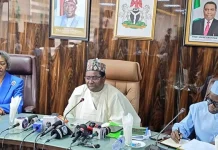
Diri’s move came just days after Bauchi State Governor Bala Mohammed, who also chairs the PDP Governors’ Forum, expressed alarm over the increasing exodus of governors and senior party members to the APC.
Insiders within both parties hinted that Rivers State Governor Siminalayi Fubara and Abia State Governor Alex Otti are next in line to declare for the ruling party, while Plateau State Governor Caleb Mutfwang and Taraba State Governor Agbu Kefas are reportedly in advanced talks with APC officials.
A senior APC official disclosed that “negotiations are ongoing with several PDP governors across the South and North. Governors from Abia, Rivers, and even Bayelsa are aligning with the APC. Discussions are also in progress with governors from the North Central and North East zones.”
Another party source added that the defections are part of a broader strategy to weaken the PDP’s influence nationwide and strengthen Tinubu’s base before the 2027 polls.
In recent months, several high-profile politicians have joined the APC from the opposition, including Akwa Ibom State Governor Umo Eno, Delta State Governor Sheriff Oborevwori, and the PDP’s 2023 vice-presidential candidate, Ifeanyi Okowa.
With the latest wave of defections, APC now controls 11 of the 17 states in southern Nigeria—Lagos, Ogun, Ekiti, Ondo, Edo, Akwa Ibom, Cross River, Delta, Imo, Ebonyi, and Enugu. The Labour Party holds Abia, while the All Progressives Grand Alliance (APGA) governs Anambra. The PDP maintains control in Oyo, Rivers, and Osun, while Bayelsa remains politically unsettled.
In the northern region, APC dominates 13 of the 19 states, including Kwara, Niger, Nasarawa, Kogi, Benue, Kaduna, Katsina, Sokoto, Kebbi, Gombe, Borno, Yobe, and Jigawa. The PDP governs Zamfara, Plateau, Taraba, Adamawa, and Bauchi, while the New Nigeria People’s Party (NNPP) retains Kano.
Reacting to the growing defections, Bauchi State Governor Bala Mohammed admitted in Abuja on Saturday that the development had shaken the PDP but insisted that internal reconciliation efforts were ongoing ahead of the party’s national convention scheduled for November 15–16 in Ibadan.
“If you ask whether I’m concerned about our governors leaving for the APC, I am more than concerned,” Mohammed said. “But leadership comes with responsibility, and while I cannot dictate my colleagues’ choices, much is being done behind the scenes to hold the party together.”
Meanwhile, the Minister of the Federal Capital Territory (FCT), Nyesom Wike—himself a PDP member who has long been accused of aligning with the ruling party—reacted to the defections with sarcasm, saying that those who once accused him of betraying the PDP are now joining the APC.
Speaking at the flag-off of the construction of the Main Carriageways on the Outer Southern Expressway in Abuja on Wednesday, Wike quipped that his critics should commend him for “paving the way” for their eventual alignment with the APC.
“I’ve been watching on television and social media. The same people who said I wanted to destabilize the PDP and work for the APC are now in the APC. If that’s true, then they should thank me for helping them get there,” Wike said.
The FCT Minister further praised President Tinubu’s “decisive leadership,” noting that his policies had stabilized fiscal flows and empowered states financially.
“Today, under the current leadership, every state has sufficient resources not only to pay salaries but also to carry out major development projects. This was not the case before. Banks are now courting states instead of the other way around,” he added.
Wike described the ongoing political realignments as a positive development for national progress, asserting that governors now have better financial capacity to deliver on their mandates without leaving behind huge debts.
“If more governors are aligning with the president’s vision, that is commendable. What this country needs now is visionary and purposeful leadership that can take bold decisions for long-term stability,” he said.
As the political landscape continues to shift, analysts believe that the coming months will determine whether Nigeria’s multiparty democracy can withstand the growing consolidation of power within the ruling APC.
The Punch Newspaper