





KEY POINTS
- Multiple suicide bombings rocked Maiduguri, Borno State, on Monday evening, resulting in 23 confirmed deaths and 108 injuries.
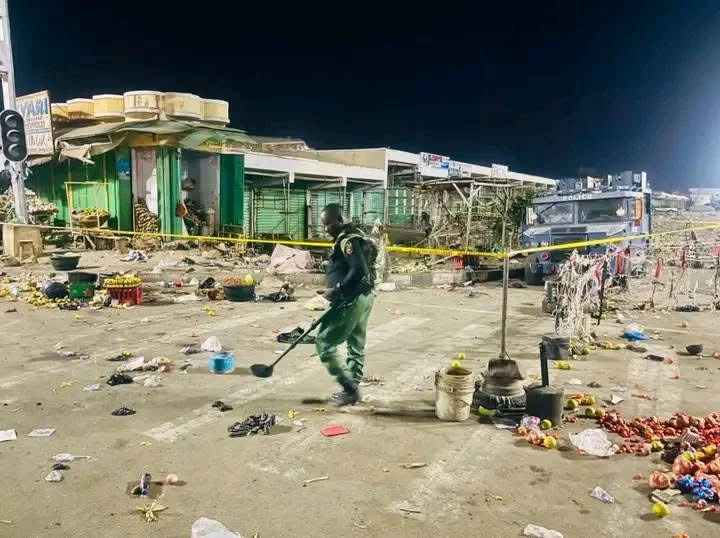
- The attacks occurred simultaneously around 7:24 p.m. at three high-traffic locations: the Maiduguri Central Market (Monday Market), the University of Maiduguri Teaching Hospital (UMTH) gate, and the Post Office Flyover.
- Improvised Explosive Devices (IEDs) were identified by police as the weapons used by the suspected suicide bombers in the coordinated strike.
- Security has been heightened across the metropolis following a sweep by the Explosive Ordnance Disposal (EOD) Unit to ensure no secondary devices remained in the area.
MAIN STORY
The Borno State Police Command has officially confirmed the deaths of 23 people following a series of coordinated suicide bombings that tore through the state capital, Maiduguri, on Monday night. ASP Nahum Daso, the command’s spokesperson, released a statement on Tuesday detailing that 108 others sustained various degrees of injuries in the blasts, which occurred at approximately 7:24 p.m.
The attackers targeted three of the city’s most sensitive and crowded areas: the popular Monday Market, the entrance to the University of Maiduguri Teaching Hospital, and the Post Office Flyover. Preliminary investigations by the police indicate that the explosions were triggered by suspected suicide bombers using improvised explosive devices (IEDs).
Immediately following the reports, a combined team of Police Tactical Units and military personnel cordoned off the affected scenes. The Commissioner of Police, Naziru Abdulmajid, conducted an on-the-spot assessment of the damage and met with victims and their families. Emergency responders from the National Emergency Management Agency (NEMA) and the Borno State Emergency Management Agency (SEMA) worked through the night to evacuate survivors to medical facilities for urgent treatment.
While no group has yet claimed responsibility for the carnage, the timing and nature of the attacks bear the hallmarks of insurgent activity. ASP Daso assured residents that “normalcy has been restored” and that security protocols have been significantly tightened across the metropolis to forestall further incidents.
WHAT’S BEING SAID
- “The command’s spokesperson… said preliminary investigations indicated that the explosions were carried out using improvised explosive devices (IEDs) by suspected suicide bombers.”
- “Commissioner of Police… visited the scenes for an on-the-spot assessment and commiserated with victims and their families.”
- “Security had been heightened across the metropolis to forestall further incidents,” stated ASP Nahum Daso.
WHAT’S NEXT
- Medical Updates: NEMA and SEMA are expected to provide updated casualty figures as victims undergo surgery and intensive care at the University of Maiduguri Teaching Hospital.
- Enhanced Surveillance: Security agencies are scheduled to maintain a heightened presence at all major markets and public entrances in Maiduguri throughout the week.
- Governor’s Assessment: Borno State Governor Babagana Zulum is expected to visit the blast sites and the hospital to coordinate further relief efforts for the families of the deceased.
BOTTOM LINE
The Bottom Line is that the coordinated nature of these bombings signals a dangerous breach of security in a city that has fought hard for stability. With over 100 people injured and three key infrastructure points hit, the pressure is now on the Borno State security apparatus to prove they can protect “soft targets” like markets and hospitals from asymmetric threats.