







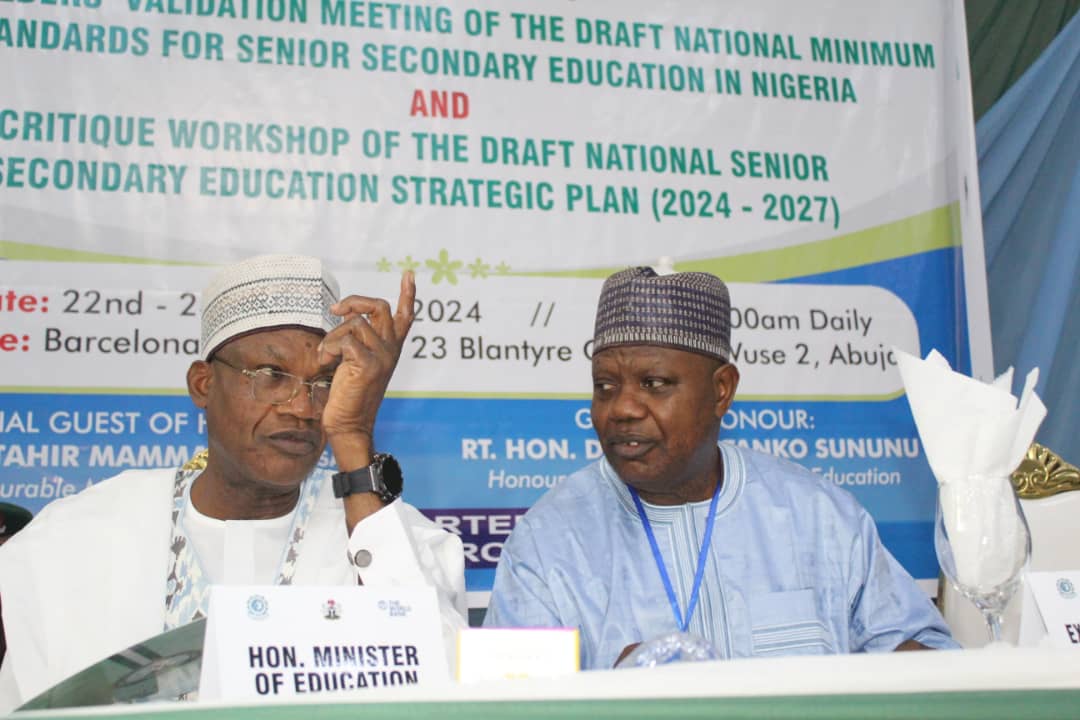
The Federal Government has announced its plan to complete the nationwide implementation of the newly approved National Minimum Standards for Senior Secondary Education within the next nine months, setting a clear timeline for transforming the country’s secondary education framework.
Developed by the National Senior Secondary Education Commission (NSSEC), the standards were officially ratified during the 68th National Council on Education, held from October 7 to 10, 2024. The policy document was later unveiled by Minister of Education, Tunji Alausa, in February 2025.
Speaking during the flag-off of the 2025 Quality Assurance Monitoring and Evaluation Exercise in Kaduna, the Executive Secretary of the NSSEC, Iyela Ajayi, stated that the initiative is geared towards improving the academic performance and overall learning environment across Nigeria’s senior secondary schools.
Ajayi emphasized that the government, under the leadership of President Bola Tinubu, is committed to elevating the education sector, recognizing it as a cornerstone of national development.
“Our objective is to ensure that every senior secondary school offers a learning atmosphere conducive to academic excellence, critical thinking, and holistic student development,” Ajayi stated.
He reaffirmed that the approved standards will serve as a baseline for evaluating educational performance across the country. “Copies of these standards were distributed to state representatives during the launch event and are expected to be implemented over the next nine months. Upon completion, the Commission will begin full enforcement,” he added.
The new framework will be enforced through comprehensive monitoring and evaluation protocols aimed at measuring learning outcomes, identifying institutional strengths and gaps, and enhancing accountability. The goal, according to Ajayi, is to ensure that best practices become the norm across all senior secondary schools.
“The programme is designed to empower educators by offering them valuable feedback and support, thereby enhancing their teaching capacities and ultimately improving student outcomes,” he said.
During the launch event at Federal Government College, Malali, Kaduna State Commissioner for Education, Muhammad Bello, praised the initiative, expressing gratitude that Kaduna was chosen as the launch site for the 2025 quality assurance programme. Represented by the Director of the Kaduna State Schools Quality Assurance Authority, Usman Zaria, Bello pointed out that monitoring and evaluation had long been a missing piece in the state’s education ecosystem.
He further remarked that despite significant financial investments made by the Kaduna State Government in education, there had been limited impact due to the absence of a robust evaluation mechanism. Bello pledged the state’s full support for NSSEC’s efforts to ensure consistent educational quality.
As the implementation phase moves forward, the Federal Government is expected to collaborate with state education ministries, school administrators, and teachers’ unions to ensure seamless integration of the standards into the academic framework of senior secondary schools across Nigeria.