







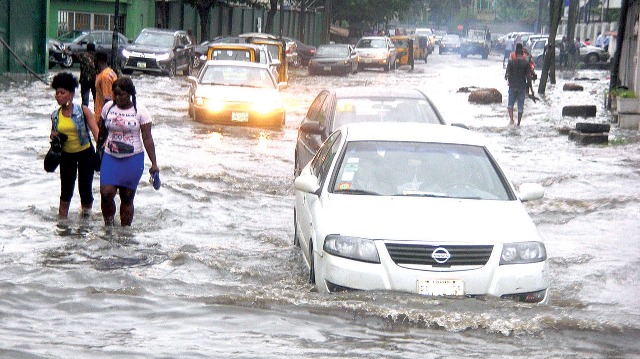
The Federal Government has issued an urgent flood alert across 19 states and 76 communities, warning that sustained rainfall over the next five days could trigger severe flooding in high-risk areas nationwide. The advisory, released Tuesday by the National Flood Early Warning Systems Centre under the Federal Ministry of Environment, comes amid worsening weather conditions that have already led to fatalities, displacement, and property damage in several parts of the country.
The centre’s forecast, covering August 5 to August 9, identifies vulnerable locations in Akwa Ibom, Bauchi, Ebonyi, Cross River, Nasarawa, Benue, Kaduna, Katsina, Kebbi, Kano, Niger, Plateau, Taraba, Jigawa, Yobe, Zamfara, Sokoto, Borno, and Gombe States.
In a separate report, the National Emergency Management Agency (NEMA) disclosed that no fewer than 191 lives have been lost to flooding incidents in 2025 alone, with 94 persons still unaccounted for. The agency said over 134,000 individuals across 20 states have been affected by various degrees of flooding, with more than 48,000 people displaced.
NEMA’s disaster dashboard shows that 239 people have sustained injuries, while 9,499 homes and 9,450 farmlands have been damaged. Among those affected are over 60,000 children, 5,700 elderly persons, and nearly 2,000 individuals living with disabilities.
Recent flooding in Ogun and Gombe states illustrates the severity of the crisis. In Ogun, flash floods trapped residents and churchgoers attending the Redeemed Christian Church of God annual convention at Redemption City. Parts of the Lagos-Ibadan Expressway were submerged, while residents in communities like Estate 15 abandoned their vehicles and resorted to canoes for transportation. Church officials deployed school buses to assist stranded attendees.
In Gombe, the State Emergency Management Agency confirmed four fatalities and damage to over 278 households across local government areas including Gombe, Kwami, Billiri, and Dukku. Officials linked most of the deaths to structural collapses caused by intense rain and cracked building walls.
Elsewhere, Lagos State experienced flash floods on Monday following overnight rainfall that overwhelmed drainage systems and crippled movement across the metropolis. Areas such as Ikorodu, Lekki, Agege, Surulere, and Eti-Osa were hit. Viral videos on social media showed flooded homes, stranded commuters, and residents wading through waist-deep water. Markets were shut down and schools forced to close, further amplifying the disruption.
In Delta State, flooding has already submerged parts of Sapele and Oko communities, prompting residents to begin relocating. Similar scenes were reported in Anambra and Plateau states, where overflowing rivers cut off access routes and destroyed farmland.
Reacting to the crisis, the National Economic Council recently approved a nationwide intervention package to support emergency flood response. Each of the 36 states and the Federal Capital Territory will receive N3 billion, while N1.5 billion has been allocated to the Ministries of Environment, Budget and National Planning, and Water Resources. The National Emergency Management Agency received an additional N10 billion.
Despite repeated warnings, experts say Nigeria’s flood risk remains dangerously high due to poor urban planning, blocked drainage systems, unregulated construction, and limited enforcement of environmental laws.
Last year, over 5.2 million people were affected by flooding across 35 states, with 1,237 fatalities and the destruction of more than 116,000 houses. The collapse of the Alau Dam in Borno alone displaced over 419,000 people.
With forecasts predicting more heavy rainfall in the days ahead, NEMA has called on residents, local authorities, and stakeholders to take immediate preventive action and remain alert.