










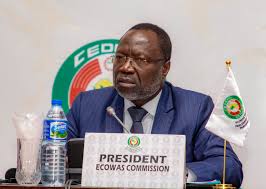
The Economic Community of West African States (ECOWAS) has announced plans to raise an annual budget of $2.5 billion to activate a 260,000-strong rapid deployment counter-terrorism brigade, signalling one of the bloc’s boldest military initiatives to date in the face of worsening insecurity in the region.
The move, unveiled at the 2025 African Chiefs of Defence Staff Summit in Abuja, comes amid warnings that the Sahel has become the epicentre of global terrorism, accounting for more than half of worldwide terrorism-related deaths in 2024 alone.
Urgent response to a deepening crisis
ECOWAS Commission President, Omar Touray, represented by the Commissioner for Political Affairs, Peace and Security, Ambassador Abdel-Fatau Musah, told defence chiefs that the proposed force would provide rapid intervention capacity, logistics, and direct support to frontline states under siege from extremist groups.
“West Africa, in particular the Sahel sub-region, has emerged as the epicentre of global terrorism, with several analytical surveys indicating that the Sahel accounted for 51 per cent of global terrorism deaths in 2024 alone,” Touray said.
While ECOWAS has long pursued the creation of a 5,000-man brigade under the African Peace and Security Architecture, Touray noted that current realities demand a larger, more agile structure. The 260,000-man force, he explained, would address asymmetric threats that have defied conventional responses.
A joint meeting of defence and finance ministers is scheduled for Friday in Abuja to finalise funding modalities for the force. ECOWAS also hopes to secure multilateral backing, including the redemption of the United Nations Security Council Resolution 2719 pledge, which promises to cover 75 per cent of African-led peace support operations.
Beyond terrorism: maritime security and organised crime
Touray added that the regional bloc is also advancing plans to operationalise its integrated maritime security strategy, anchored on three regional maritime centres and a coordinating hub in Abuja. The initiative is designed to combat piracy and transnational organised crime that threaten the Gulf of Guinea and wider regional stability.
Experts call for African solutions
Former Minister of External Affairs, Prof. Ibrahim Gambari, warned that Africa is now grappling with more than 1,000 insurgent groups, citing findings from the African Research Network for Regional and Global Governance Innovation.
He urged African states to strengthen homegrown defence industries, invest in indigenous technologies, and design security architectures tailored to the continent’s realities.
“Africa’s collective security can only be enhanced with active, practical, and proactive collaboration at regional and continental levels,” Gambari stressed, calling for joint training, interoperability of armaments, shared intelligence, and improved capacity in airlift and logistics.
Nigeria urges modernisation and unity
Nigeria’s Chief of Defence Staff, General Christopher Musa, echoed these sentiments, describing Africa as standing “on the edge of unprecedented opportunity” due to its youthful population and resources, but warned that violent extremism, organised crime, piracy, and climate-induced conflicts threaten to erode those prospects.
“These challenges recognise no borders. They are resilient and demand a response that is equally dynamic, unified, and strategic,” Musa said.
He noted that the nature of warfare is shifting, with new threats emerging in cyberspace and digital domains, and urged African militaries to invest in cyber defence, artificial intelligence, and indigenous military technologies.
“The enemy is within. As chiefs of defence staff, we must lead the charge in modernising our forces. Without such investments, it will be difficult to achieve the security we desire,” Musa cautioned.
The proposed counter-terrorism brigade represents a turning point for ECOWAS, reflecting both the urgency of the region’s security crisis and the bloc’s ambition to take ownership of its defence architecture.
Yet questions remain over funding, political will, and the ability of member states to sustain such an ambitious force. For now, ECOWAS leaders are betting that shared resolve and stronger collaboration will turn the tide in a region struggling to keep its people safe.









 has announced plans to raise an annual budget of $2.5 billion to activate ...)