






Key Points
- The ECOWAS Parliament has launched an investigation into escalating terror attacks in West Africa and xenophobic violence in South Africa.
- The Committee on Political Affairs is specifically tasked with investigating incidents in Mali and Burkina Faso, alongside attacks targeting ECOWAS citizens in South Africa.
- Recent atrocities cited include the execution of 18 Ghanaian traders in Burkina Faso and an attack in Mali that killed the country’s Defence Minister.
- Lawmakers highlighted the failure to uphold the 1979 Free Movement Protocol, noting that citizens continue to face harassment and safety risks at borders.
- The Parliament intends to send formal communications to South Africa’s parliament and the African Commission on Human and Peoples’ Rights.
Main Story
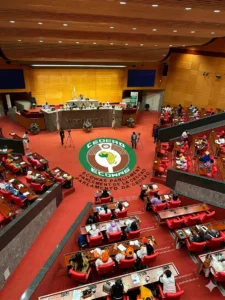
During the First 2026 Ordinary Session in Abuja, the ECOWAS Parliament moved to address a dual crisis threatening the safety and economic livelihoods of regional citizens.
The decision followed an urgent motion by Ghanaian MP Alexander Afenyo-Markin, who emphasized that a regional community must be able to protect its citizens in transit.
The investigation will focus on the surge of militant activity in the Sahel and the recurring wave of xenophobic violence in South African cities like Cape Town and Pretoria.
Afenyo-Markin pointed to the February 14 massacre in northern Burkina Faso as a primary example of the worsening security situation, where militants executed 18 traders who were essential to the regional food supply chain.
Furthermore, the April 25 assassination of Mali’s Defence Minister has effectively paralyzed key trade routes, leading some foreign ministries to warn that they can no longer guarantee the safety of travelers.
The Parliament is now calling for immediate accountability from both regional security forces and the South African government to move beyond ceremonial condemnations toward actual prosecutions.
The Issues
- Terrorist attacks are cutting off vital supply chains that feed regional markets.
- Ceremonial remarks by leadership in South Africa are described as insufficient because they do not lead to the arrest of perpetrators.
- There is a growing concern that the regional body is not meeting its promise to protect West African nationals in transit.
- Despite regional commitments, citizens continue to experience daily contradictions to the promise of free movement.
What’s Being Said
- “A regional community that cannot protect its own citizens in transit has not yet earned its name.” — Alexander Afenyo-Markin
- “Words delivered from a ceremonial platform do not arrest a single perpetrator.” — Alexander Afenyo-Markin
- The traders killed were “the quiet engines of the regional supply chain that feeds our markets.” — Alexander Afenyo-Markin
- The safety of citizens “must never be a matter open to devastation.” — Alexander Afenyo-Markin
What’s Next
- The Committee on Political Affairs will begin its formal probe into recent terror and xenophobic incidents.
- Formal notices will be dispatched to the South African parliament and the African Commission on Human and Peoples’ Rights.
- ECOWAS will push the South African government for transparent investigations and prosecutions of those involved in lynchings and looting.
- Lawmakers are expected to revisit the implementation of the Free Movement Protocol to address border harassment.
Bottom Line
The ECOWAS Parliament is demanding a shift from rhetoric to action, launching a multi-national investigation to protect the lives and trade routes of West African citizens currently under threat from Sahelian terrorists and South African xenophobia.