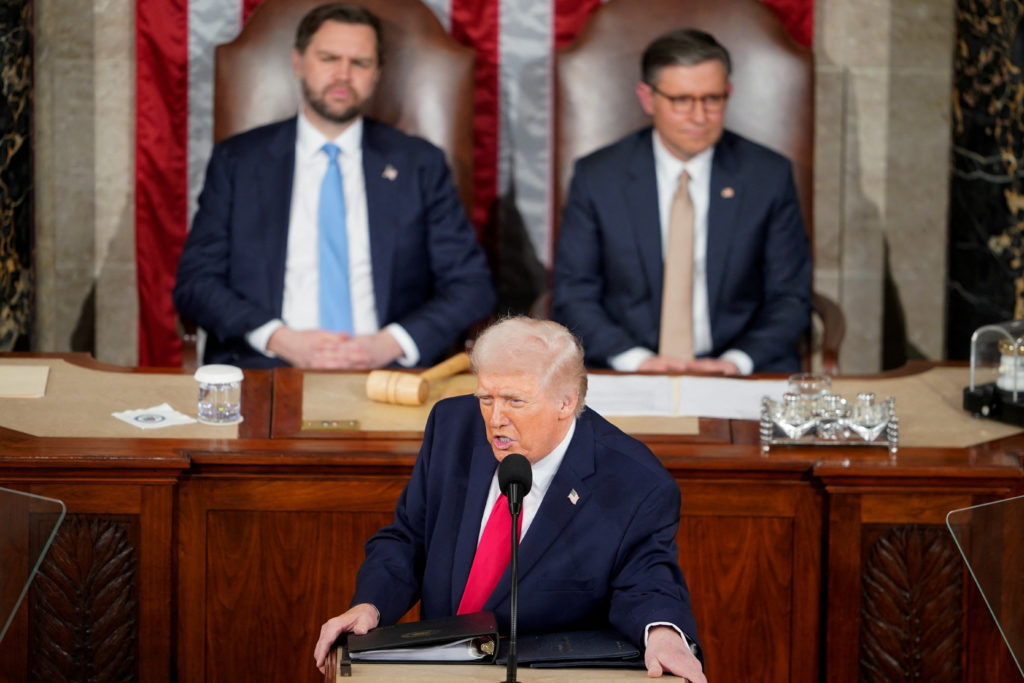
U.S. President Donald J. Trump delivered a sweeping State of the Union address late Tuesday night before a joint session of the 119th United States Congress, using the moment to underscore domestic policy achievements and rising international concerns, particularly over escalating tensions with the Islamic Republic of Iran.
The speech, delivered in the House Chamber at the U.S. Capitol, lasted approximately 1 hour and 48 minutes, setting a new record for the longest address of its kind in American history. Presiding over the session were House Speaker Mike Johnson and Vice President J.D. Vance, both seated behind the president as he delivered his remarks.
Domestic Messaging and Policy Highlights
President Trump opened his address by framing the current state of the nation as one of strength and resurgence. He claimed significant progress on inflation, job creation, and border security — declaring inflation “plummeting” and border enforcement at “historic strength.” Trump also recognized individuals exemplifying national resilience, including members of the men’s U.S. Olympic hockey team and a U.S. Coast Guard rescue swimmer honored for lifesaving efforts during the Central Texas floods.
Partisan divisions were visible throughout the address. Frequent applause lines from Republican lawmakers contrasted sharply with visibly reserved responses from Democratic members. Social media reactions were equally divided, with some critics dismissing the speech’s tone as resembling a campaign rally more than a unifying national address.
Iran Policy: Diplomacy Coupled with Firm Stance
Notably, President Trump used a portion of the speech to address the increasingly fraught U.S.–Iran relationship. Emphasizing that he “prefers to resolve tensions through diplomacy,” Trump nevertheless warned that the United States would not tolerate Tehran developing nuclear weapons, reaffirming that diplomatic negotiations must include Iran’s explicit renunciation of nuclear ambitions.
Trump reiterated unverified claims that Iran is attempting to rebuild its nuclear infrastructure following U.S. strikes last year, and he accused Tehran of advances in long-range missile capabilities. He also insisted that Iran must unequivocally agree never to pursue nuclear weapons as a condition of further negotiations.
Iranian officials have rejected these assertions, referring to them as “big lies” and maintaining that its nuclear program remains purely civilian in nature. Independent international inspections, including those by the UN’s nuclear watchdog, have not confirmed that Tehran is pursuing a weapons program.
Global Security Context and U.S. Forces in the Middle East
The diplomatic dialogue over Iran comes amid broader regional apprehension. In recent weeks, the United States advised a repositioning of some military personnel at key bases across the Middle East amid tensions sparked by threats of conflict and ongoing protests within Iran. Qatar’s Al Udeid Air Base, a central U.S. command hub in the region, and other installations have been highlighted by local defense officials as potential flashpoints should hostilities increase.
Political and Public Reaction
Responses to the speech reflected growing polarization in American politics. On social platforms, commentators disagreed sharply over the speech’s tone and substance — some praising Trump’s assertive policy framing, others condemning it as excessively combative and lacking cohesive national unity.
Beyond domestic reactions, international observers have pointed to the address as a critical signal of the U.S. administration’s priorities mid-way through Trump’s second term. Its timing aligns with key legislative and geopolitical challenges that will shape U.S. policy for the months ahead.
Conclusion
President Trump’s 2026 State of the Union Address defined a clear vision for his administration’s legislative and foreign policy objectives. With economic claims, immigration priorities, and heightened rhetoric toward Iran, the address is likely to inform both domestic debate and foreign policy analysis in the coming months. As diplomatic efforts with Tehran continue, U.S. allies and regional actors alike will be watching for signs of escalation or de-escalation following this high-profile speech.