








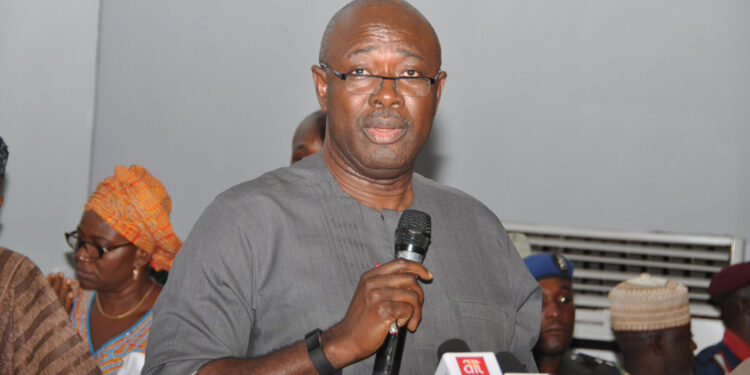
Africa is currently sitting on nearly $4 trillion in local capital, spread across pension funds, sovereign wealth funds, and insurance assets that must be unlocked to end the continent’s energy crisis. This was the core message from the Minister of State for Petroleum Resources (Oil), Senator Heineken Lokpobiri, during his keynote address at the 10th Sub-Saharan Africa International Petroleum Exhibition and Conference (SAIPEC) in Lagos on February 10, 2026.
Lokpobiri argued that the biggest obstacle to Africa’s energy security is no longer a lack of resources, but a “capital crunch” caused by the weaponization of external financing against fossil fuel projects.
To dismantle this financial barrier, Nigeria has officially handed over the fully furnished headquarters of the Africa Energy Bank (AEB) in Abuja to its promoters, APPO and Afreximbank.
Lokpobiri revealed that Nigeria has already covered about 70% of its capital subscription and pledged that the federal government would bridge any remaining funding gaps to ensure the bank’s operational takeoff by April 2026. The AEB is positioned as the continent’s primary defense against international divestment, providing a dedicated credit line for oil, gas, and renewable projects that global lenders are increasingly shunning.
The Minister also issued a stern warning against the “middleman culture” that has historically inflated the cost of energy projects in Africa. He noted that the continent spends over $120 billion annually on imported hydrocarbon services and refined products, a massive outflow that leaves little value behind.
By leveraging the Petroleum Industry Act (PIA) and new executive orders, Nigeria is pushing for a “performance-driven” local content model. Lokpobiri challenged indigenous service providers to take ownership of global standards, warning that “portfolio companies” without real technical capacity are damaging the reputation of African industry and driving up production costs.
The “Energy Mix” Mandate
Lokpobiri’s address marked a definitive push to change the global narrative from “energy transition” to a realistic “energy mix.” Citing recent policy shifts by the International Energy Agency (IEA), he noted that even global watchdogs now acknowledge that fossil fuels will account for over 50% of global energy consumption for the foreseeable future.
For Africa, where 600 million people still lack basic electricity, the Minister insisted that natural gas must remain the “bridge fuel” for industrialization. He concluded by urging African nations to repatriate their overseas assets into the AEB, asserting that Africa has the money to power its own future if it finds the courage to invest in itself.







, Senator Heineken Lokpobiri, during his keynote address at the 10th Sub-Saharan Africa International Petroleum Exhibition and Conference (SAIPEC) in Lagos on February 10, 2026.)