




By BizWatch
KEY POINTS
- Confidence in domestic economic conditions among African CEOs rose to 72 per cent, but fewer expect earnings growth of at least 2.5 per cent than their global counterparts.
- Although 72 per cent of African CEOs prioritise AI investment, only 14 per cent believe their organisations are keeping pace with or leading in AI capabilities.
- Workforce skills, AI training, cybersecurity and sustainability integration remain key challenges for businesses across the continent.
MAIN STORY
African business leaders are increasingly confident about economic conditions and revenue growth, but gaps in artificial intelligence capabilities, workforce skills and execution could constrain their ambitions, according to the KPMG Africa CEO Outlook 2026.
The findings were presented at the report’s launch in Lagos on Thursday, where KPMG executives examined the economic outlook, technology investment, workforce transformation, and resilience and sustainability priorities facing businesses across Africa.
Opening the event, Tola Adeyemi, Chief Executive Officer for KPMG One Africa, said the survey was designed to help business leaders make investment and capital allocation decisions by providing perspectives from fellow executives operating in an uncertain global environment.
Adeyemi said the survey covered 1,400 chief executives globally, including 176 in Africa, and examined four interconnected areas: economic growth, technology and artificial intelligence, talent, and resilience and sustainability. He noted that Africa’s different regions faced distinct business conditions and priorities.
Presenting the economic findings, Frank Blackmore, Lead Economist, Research & Insights at KPMG Nigeria, said 66 per cent of African CEOs were confident in the global economy, six percentage points higher than the previous year. Confidence in domestic economic conditions increased by nine percentage points to 72 per cent.
Revenue performance was also encouraging, with 86 per cent of respondents reporting growth in their last financial year. However, expectations for sustained earnings growth were more restrained. Only 58 per cent of African CEOs expected annual earnings growth of at least 2.5 per cent over the next three years, compared with 68 per cent globally.
Blackmore identified cybersecurity and data security, supply chain resilience, AI integration and geopolitical instability among the leading threats to business growth. He also highlighted cybersecurity and digital resilience, regulatory compliance and reporting, and AI integration as investment priorities, adding that businesses needed to improve productivity, strengthen customer experience and make decisions faster.
The technology findings revealed a substantial gap between AI investment ambitions and organisational readiness. Ladi Asuni, Partner and Head of Tech Platforms at KPMG in Nigeria, said 72 per cent of African CEOs identified AI as a top investment priority, compared with 79 per cent globally. Yet only 14 per cent believed their organisations were keeping pace with or leading in AI capabilities, against 66 per cent globally.
The time required to realise returns presents another challenge. Asuni said 42 per cent of African CEOs expected their AI investments to take more than three years to deliver returns, compared with 12 per cent of their global counterparts. He said businesses needed to address data readiness, workforce capabilities, governance and trust to convert investment into measurable value.
Workforce transformation presents a related challenge. Abena Ohenewaa Appiah, SHRM-SCP, Associate Director at KPMG Ghana, said 59 per cent of African CEOs identified workforce skills as a significant gap, while 58 per cent cited AI training and upskilling as a critical challenge.
Despite these concerns, 84 per cent expected their organisations’ headcount to grow over the next three years, even as 56 per cent anticipated workforce reductions. Appiah highlighted the need for businesses to identify tasks suitable for automation, redesign roles, retrain existing employees and develop capabilities aligned with future operational needs.
Sustainability integration also lagged behind global levels. Tomi Adepoju, Partner and Head of Enterprise Risk and ESG Services at KPMG in Nigeria, said 48 per cent of African CEOs were embedding sustainability more deeply into their core strategies, compared with 63 per cent globally.
Only 22 per cent of African CEOs comprehensively considered sustainability costs, risks and returns in every major capital decision, against 29 per cent globally. Adepoju said 41 per cent prioritised energy demand optimisation, while 30 per cent focused on obtaining lower-carbon energy from external suppliers.
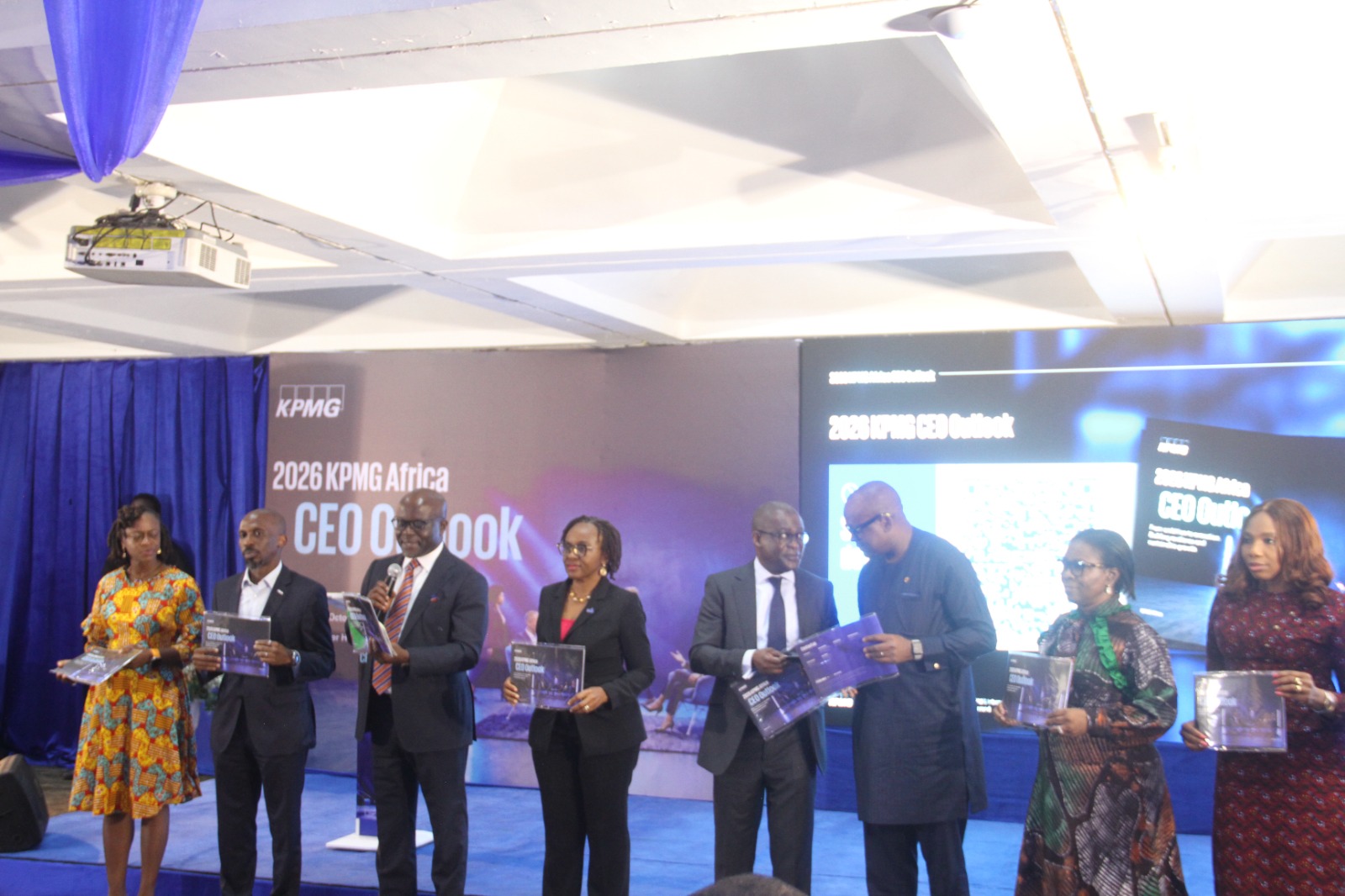
At the launch, Adeyemi formally unveiled the KPMG Africa CEO Outlook 2026, which is available in hard-copy and digital formats. He said African businesses had significant opportunities but needed to focus on execution, talent, AI, customer value and resilience.
Closing the event, Sheun Sowole, Partner and Head of Client & Market at KPMG Africa, reiterated the importance of execution, resilience, disciplined capital allocation, responsible AI adoption, talent development and policy certainty for African businesses.
THE ISSUES
The findings point to a gap between what African CEOs want their businesses to achieve and their organisations’ capacity to deliver. Rising economic confidence and recent revenue growth indicate that many businesses see opportunities, but expectations for future earnings remain below the global benchmark.
AI illustrates this challenge particularly clearly. While investment interest is substantial, the low proportion of executives who believe their organisations are keeping pace with technological developments suggests that spending alone may not be enough. Data quality, staff capabilities, governance and the ability to integrate AI into everyday operations will influence whether investments produce returns.
The workforce figures also reveal competing pressures. Many CEOs expect to hire more employees, while a substantial proportion anticipate workforce reductions. These expectations may reflect different needs across roles and businesses, including the possibility of automating some tasks while recruiting for others. The findings underline the importance of planning workforce transitions rather than treating technology adoption and employment growth as mutually exclusive.
Sustainability presents a similar implementation challenge. Fewer African CEOs reported embedding sustainability into core strategy or consistently factoring its costs and returns into major capital decisions than CEOs globally. Energy optimisation and lower-carbon energy sourcing are among the approaches identified, but the figures suggest that sustainability considerations are not yet equally integrated into all investment decisions.
For Nigerian businesses, the findings raise practical questions about how firms can allocate scarce capital among technology, cybersecurity, workforce development and energy efficiency while managing regulatory obligations and uncertainty. The survey offers a view of executive priorities, but it does not establish that all African markets or businesses face the same conditions.
WHAT’S BEING SAID
“Ambition alone will not lead to growth.” – Tola Adeyemi, Chief Executive Officer for KPMG One Africa
“How do we convert sustainability as a mission into measurable business value?” – Tomi Adepoju, Partner and Head of Enterprise Risk and ESG Services, KPMG in Nigeria
“Confidence holds, but execution will shape the next phase of growth.” – Frank Blackmore, Lead Economist, Research & Insights, KPMG Nigeria
WHAT’S NEXT
The key test for African businesses will be whether they can translate confidence and investment plans into measurable operational improvements and sustained earnings growth.
Companies are likely to face continued pressure to demonstrate returns from AI spending, strengthen cybersecurity and data governance, and equip employees for changing roles. The extent to which they can combine automation with workforce development may also shape their hiring and restructuring decisions.
Sustainability investment decisions will remain another area to watch, particularly whether businesses move from broad commitments to more consistent assessments of energy costs, risks and returns when allocating capital.
The report’s findings also leave room for closer examination of differences among African countries and industries. Such comparisons could help establish how much of the execution gap reflects common constraints and how much depends on local infrastructure, regulation, skills availability and access to capital.
BOTTOM LINE
African CEOs are increasingly confident about economic conditions, but the KPMG outlook suggests that confidence is not yet matched by comparable readiness in AI, workforce skills and sustainability integration. Turning ambition into stronger business performance will depend on execution, disciplined investment and the ability to build the capabilities needed to deliver results.