





By David Oputah
I have replayed that clip in my head more times than I care to admit. A former governor, a man who has occupied some of the most powerful offices in this country, sitting comfortably on national television and openly admitting that “someone tapped” the phone of the National Security Adviser. Then adding, almost casually, that the government listens to calls all the time without court orders anyway. SHOCKING, isn’t it?
We live in a country where words are currency and power is leverage. You do not casually confess to an illegality in an environment where you have openly positioned yourself as an adversary to the ruling establishment. Especially not in Nigeria, where institutions may move slowly but once provoked, they can move with astonishing speed.
Let’s retrace the drama.
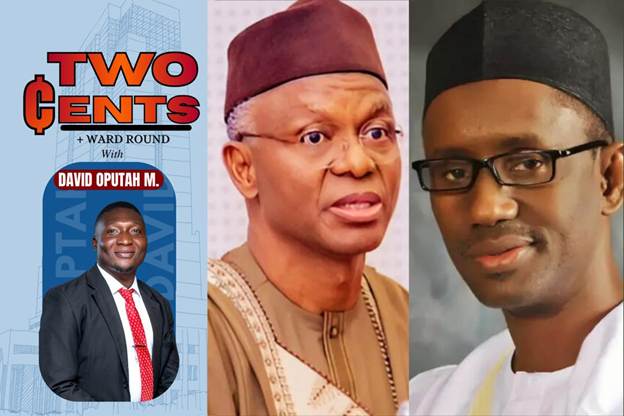
Former Kaduna State Governor Nasir El-Rufai returned to Nigeria and reportedly faced an attempted detention by operatives of the Department of State Services. Then came the Arise TV interview. On Prime Time, he claimed that an intercepted call involving Nuhu Ribadu had revealed instructions to security operatives to arrest him. He did not just allege surveillance. He admitted to benefiting from it. He acknowledged that phone tapping is illegal. Then he justified it by saying government does it all the time.
Soon after, the DSS filed a three-count charge at the Federal High Court in Abuja, citing violations of the Cybercrimes (Prohibition, Prevention, etc.) Amendment Act 2024 and the Nigerian Communications Act 2003. Then came the raid on his Abuja residence by ICPC officials.
Now here is where my 2 cents begins in earnest.
Why would a politically exposed person, experienced in power games and security architecture, admit to unlawful interception on live television? What was the calculation? Was it bravado? Was it strategy? Or was it a signal?
One possible interpretation is that this is political brinkmanship. By publicly admitting that “we also have our ways,” he may have been attempting to demonstrate that the surveillance state cuts both ways. That power is not monopolized. That if you listen to us, we listen to you. A kind of mutually assured exposure. But that is dangerous territory.
Because the crux of the matter is not whether the government taps phones. The crux is this: do we want to normalize illegality simply because we believe the other side is guilty too? Two wrongs do not suddenly become constitutional.
If the government has indeed been engaging in unlawful surveillance, that should be challenged in court, investigated, exposed through lawful means. But to respond by admitting participation in the same illegality undermines the moral high ground completely. You cannot fight abuse of power with abuse of power and expect to come out clean.
There is also a deeper issue here. In Nigeria, we often treat legality as optional, something flexible depending on who is in power. When “our side” bends the rules, we rationalize it. When the “other side” does, we cry tyranny. This cycle erodes institutions. It reduces governance to a chessboard of revenge and counter-revenge.
If powerful politicians openly admit to tapping each other’s phones, what protection does the ordinary citizen have? If political actors are running parallel intelligence networks, what does that say about institutional integrity? This drama is bigger than El-Rufai. It is bigger than Ribadu. It is bigger than the ruling party versus opposition factions.
Ward Rounds
Electoral Act 2026 Signed
President Bola Tinubu has signed the Electoral Act (Amendment) Bill 2026 into law, mandating BVAS and granting INEC discretion over result transmission. On paper, this strengthens the framework. Technology-backed accreditation should reduce ghost voting and manual manipulations.
But laws are only as strong as their enforcement. We saw in previous cycles that systems can be impressive until election day logistics fail. Is this a win? Let’s hope INEC does better in 2027.
FCT Council Elections
Abuja heads to the polls this Saturday to test the new Act. A work-free day was declared, and movement restrictions begin Friday night. This is democracy at the grassroots level, where governance touches people’s lives.
Abuja residents, turn up! Local government may not trend on Twitter, but it shapes daily reality. Participation is power.
Oil Revenue Directive
The President has ordered direct remittance of oil and gas revenues to the Federation Account. On the surface, this signals transparency and fiscal discipline. Plug the leakages, follow the money.
Yet PENGASSAN is already pushing back, warning of job losses. Reform always hurts someone. Where were they before it was signed? The debate must be economic, not emotional.
World Cup Fate
A FIFA petition over DR Congo’s alleged use of ineligible players has fans watching closely. I support the Super Eagles and would love to see Nigeria at the World Cup.
But let’s be honest, the team that played against DR Congo was woeful. Qualification through paperwork cannot mask performance gaps. Fix the football first.
Naira Strength
The Naira hitting a two-year high at about ₦1,347/$ in the official market is encouraging. Inflation slowing to 15.1% for the tenth consecutive month suggests macroeconomic stabilization.
Now let this translate to purchasing power and the cost of items in the market. Exchange rate gains must reflect in market stalls and fuel stations. Until then, optimism remains theoretical.
Editors note: Views and opinions expressed in this article are not of BizWatch Nigeria
- David is a respected Media and Communications Consultant in Nigeria. He has a first degree in Mass Communication and 2 Master degrees (Organisational Behaviour and Mass Communication). He is a Bloomberg-trained financial journalist (BMIA) and a participant in the Media Innovation Programme (MIP) at the University of Johannesburg, South Africa and the Pan Atlantic University, Lagos.