









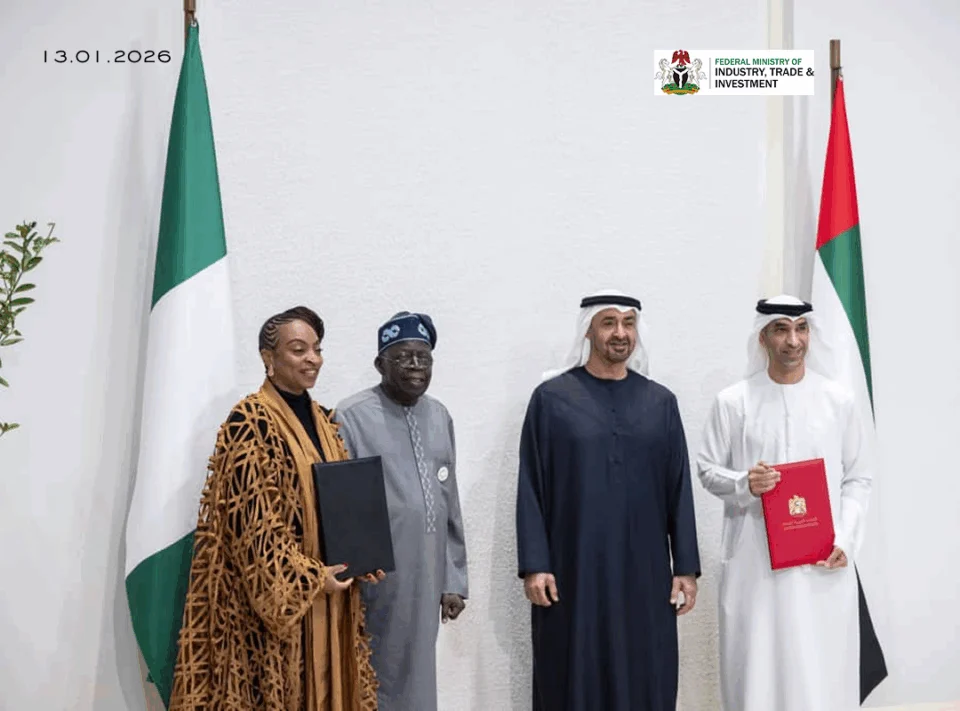
Nigeria and the United Arab Emirates (UAE) have signed a Comprehensive Economic Partnership Agreement (CEPA) aimed at eliminating tariffs on thousands of products and strengthening bilateral trade relations.
A member of the Governing Board of the North East Development Commission, Rep. Sam Onuigbo, disclosed this in an interview with the News Agency of Nigeria (NAN) on Tuesday in Abuja. He described the agreement signed in Abu Dhabi as a major breakthrough for Nigeria’s economic repositioning.
According to Onuigbo, the CEPA was finalised in January 2026 on the sidelines of the Abu Dhabi Sustainability Week held from January 11 to 15. Under the agreement, the UAE will eliminate tariffs on 7,315 Nigerian products, granting immediate duty-free access to 2,805 items—representing about 38.3 per cent—while tariffs on the remaining products will be phased out over a period of three to five years. The concessions cover a wide range of agricultural and industrial goods.
In a reciprocal move, Nigeria has also removed tariffs on 6,243 products imported from the UAE.
“This agreement creates enormous opportunities between Nigeria and the Emirates. It is massive and will provide an enabling environment for Nigerian businesspeople with verifiable and identifiable enterprises to establish offices in the UAE, work there for a period, and return with valuable experience and partnerships,” Onuigbo said.
The former Chairman of the House of Representatives Committee on Climate Change in the 8th Assembly commended President Bola Tinubu for facilitating the agreement, noting that it was strategically designed to reposition Nigeria’s economy, stimulate employment, and improve the business climate.
“Nigeria is ready for business,” he said, adding that the country’s carbon market framework policy was also unveiled in Abu Dhabi as part of broader efforts to attract sustainable investment.
Onuigbo noted that Nigeria’s participation at the Abu Dhabi summit underscored its commitment to addressing longstanding challenges in energy and power supply, which have constrained industrial growth. He cited key policy interventions such as the Energy Transition Plan, the Climate Change Act, and the Electricity Act—signed by President Tinubu shortly after assuming office in 2023—as evidence of the administration’s resolve to close the energy gap.
He further explained that reliable energy and electricity remain fundamental to Nigeria’s industrialisation and economic development agenda.
Onuigbo expressed optimism that enhanced collaboration between Nigeria and the UAE would unlock global economic opportunities, foster stronger partnerships, and help address the impacts of climate change, while significantly boosting Nigeria’s economy in 2026 and beyond.
NAN












 have signed a Comprehensive Economic Partnership Agreement (CEPA) aimed at eliminating ...)