






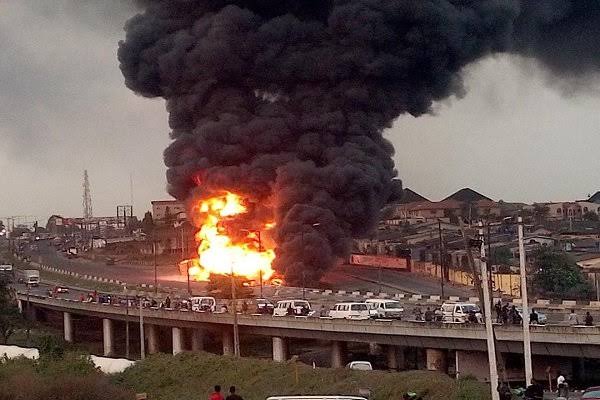
Few locations on Nigeria’s highways evoke as much dread among commuters as Otedola Bridge in Lagos and Kara Bridge at Isheri on the Lagos–Ibadan Expressway. Over the years, these two points have become synonymous with tragedy, frequent scenes of tanker explosions, articulated truck crashes, and deadly traffic pileups leading to avoidable loss of lives, goods, vehicles and productive manhour.
While some Nigerians attribute the recurring incidents to spiritual forces, a more grounded assessment reveals a troubling combination of engineering oversight, poor traffic discipline, and regulatory failure.
The two bridges share a critical design similarity: a steep gradient leading into or away from them. For heavy-duty vehicles likes tankers, trailers, and articulated trucks, this creates significant braking challenges, especially when approaching from a downslope.
When these vehicles descend the steep gradient, the combination of speed, overloaded cargo, and failing braking systems often results in total loss of control. In many cases, one mechanical failure sets off a chain reaction that claims multiple lives and vehicles. This is why such accidents are rare on the the other side inwards tollgate.
However, steep design alone doesn’t account for the accidents. The recklessness of drivers, particularly those of heavy-duty vchicles remains another major factor. Many of these drivers operate with minimal training, lack basic road safety education, and often drive under fatigue or the influence of substances like alcohol.
Beyond that, weak enforcement of speed limits, weight regulations, and vehicle inspection standards continues to embolden lawlessness. The Lagos–Ibadan Expressway is a federal artery, yet state authorities often take the burden of emergency response after each disaster.
The talk of “spiritual forces” at Otedola Bridge reflects the public’s frustration, not metaphysics. When accidents become predictable, citizens naturally look for explanations beyond reason. But these tragedies are avoidable if engineering foresight meets political will. The real “spirit” haunting Otedola and Kara bridges is definitely neglect, a mix of infrastructural decay, lax enforcement, and human indiscipline.
Towards a lasting solution, mechanical speed retarders and runaway truck ramps before the descent to both bridges should be introduced and possibly conduct a comprehensive structural and gradient re-evaluation to reduce the steep approach where feasible. Install anti-skid surfacing and ensure proper drainage maintenance to avoid surface slickness.
Another practical way to reduce accidents on Otedola and Kara bridges is through better traffic control and stronger law enforcement. The government should consider restricting the movement of articulated trucks and tankers during peak traffic hours when the roads are busiest. This would reduce the risk of collisions involving smaller vehicles. In addition, every heavy-duty vehicle that uses the Lagos–Ibadan Expressway should undergo a compulsory roadworthiness inspection at least once every six months. This will ensure that only trucks in good mechanical condition are allowed to operate.
To maintain order, there should be a permanent presence of the Federal Road Safety Corps (FRSC) and Lagos State Traffic Management Authority (LASTMA) officers stationed around both Otedola and Kara bridges. These officers should be supported by monitoring cameras to check for overloading and other safety violations as obtainable on the adjourning Nurudeen Olowo-popo way. Consistent enforcement, not just reactive measures after accidents, will help restore discipline on these routes.
Another critical step is to properly educate and monitor truck drivers. Many of them have little or no formal training on safe driving practices for long-distance and heavy-duty operations, on speed control, road safety, alcohol and drug use and the importance of vehicle maintenance. Haulage and logistics companies must take responsibility for their drivers. They should introduce a rotation or shift system that ensures no driver stays behind the wheel for too long to avoid fatigue.
In conclusion, if Lagos and Ogun States collaborate with the Federal Ministry of Works and the FRSC to implement targeted engineering and safety measures, both bridges can shed their tragic reputations. The lives lost on Otedola and Kara bridges are not sacrifices to unseen forces but casualties of human error and administrative inaction.
It is time to rebuild trust in our roads, not by prayers alone, but through engineering precision, discipline, and responsible governance.
An opinion article by Oladapo Ojo- oladapo.ojo25@gmail.com