








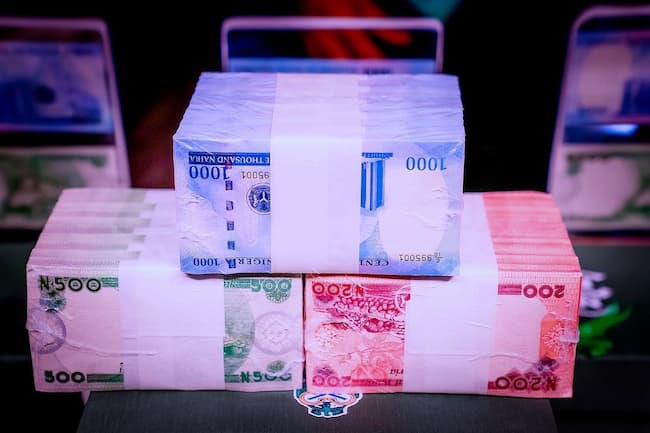
The naira posted a slight rebound against the US dollar at the official market on Monday, supported by an uptick in Nigeria’s external reserves, according to newly released Central Bank data.
The currency’s appreciation remained modest, with trading activity on the parallel market staying largely subdued as market watchers anticipated additional FX liquidity injections from the CBN.

The naira has considerably weakened throughout November, slipping from N1,426 to N1,448 at the official window despite continued FX interventions. Market pressure persisted as the spot rate touched an intraday high of N1,459 — a significant jump from the N1,450 recorded the previous session. Some trades closed at an intraday low of N1,440, unchanged from prior levels.
This trading pattern suggests that the CBN supplied dollars into the official market to prevent the spot rate from breaching its current band.
The forex market eventually closed with the naira settling at N1,447.35 per dollar — a 4-basis-point improvement from Friday’s N1,448.03. In contrast, the parallel market remained unchanged at N1,470 per dollar.
Nigeria’s external reserves increased to $43.971 billion on Monday, up from $43.64 billion, the CBN confirmed.
Meanwhile, global commodity markets saw mixed movement. Oil prices strengthened on Tuesday amid volatile trading as investors assessed the effects of Western sanctions on Russian crude and comments by U.S. President Donald Trump confirming that interviews had commenced for the next Federal Reserve chair.
Brent crude gained 67 cents, or 1.04%, to reach $64.87 per barrel, while U.S. West Texas Intermediate (WTI) crude climbed 88 cents, or 1.47%, to $60.74.
Gold prices also rose from a one-week low, backed by soft U.S. employment figures. Investors monitored the likelihood of a Federal Reserve rate cut in December as multiple U.S. data releases faced delays.
Spot gold advanced 0.81% to $4,077.57 per ounce, while U.S. gold futures saw a marginal increase of 0.04% to $4,075.96 per ounce.
Analysts anticipate continued volatility across commodities, noting that oil prices may face renewed pressure as Russian shipments resume and geopolitical risks persist, while gold could struggle due to a firmer U.S. dollar and reduced expectations of early Fed easing.