








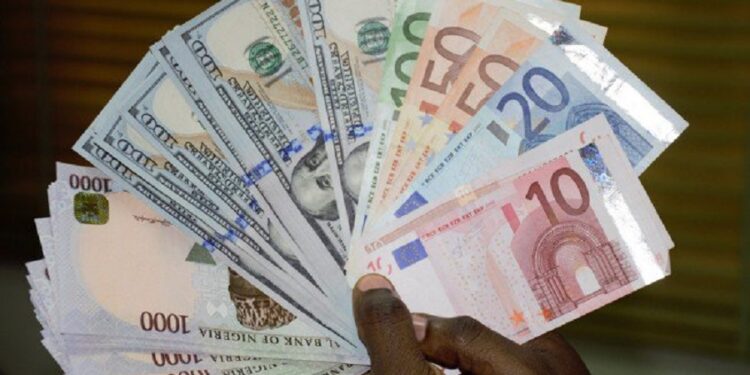
The naira traded flat across the official and parallel foreign exchange (FX) markets on Monday as weekly inflows declined by 15.7 per cent, signalling weaker FX supply and mild pressure on the local currency.
Data from the Central Bank of Nigeria (CBN) showed that the naira depreciated marginally by 72 kobo, closing at ₦1,437.29/$1 at the Nigerian Foreign Exchange Market (NFEM), compared to ₦1,436.57/$1 recorded last Friday.
At the parallel market, also known as the black market, the naira slipped further, trading at ₦1,460/$1 on Monday from ₦1,455/$1 previously. Traders attributed the weakness to a decline in dollar liquidity following reduced inflows into the market.
A market report by Coronation Merchant Bank Research revealed that total forex inflows through the NFEM dropped to $899.20 million, down from $1.04 billion in the previous week. The bank attributed the decline to reduced participation by foreign investors and corporates.
According to the report, Foreign Portfolio Investors (FPIs) remained the dominant source of FX inflows, contributing 60.13 per cent (about $540.70 million) of total liquidity. They were followed by non-bank corporates (13.99 per cent), individuals (12.75 per cent), and exporters (12.56 per cent), while other channels accounted for just 0.56 per cent.
The slowdown in inflows also ended the naira’s two-week appreciation streak, with the official rate weakening by 1.03 per cent week-on-week to close at ₦1,436.58/$1. Similarly, the parallel market rate depreciated by 1.71 per cent week-on-week to ₦1,465/$1, widening the gap between both markets to ₦28.42/$1, from ₦18.27/$1 in the preceding week.
Despite the softer inflows, Nigeria’s gross external reserves rose marginally by 0.29 per cent to $43.32 billion as of October 6, 2025 — an increase of $127.10 million week-on-week. The slight improvement was supported by the $899.20 million inflows and relatively lower outflows of $822.60 million during the review period.
Analysts at Coronation Merchant Bank maintained a cautiously optimistic outlook, forecasting that the naira will likely remain below the ₦1,500/$1 mark in the short term.
“In the near term, the naira is expected to remain stable below ₦1,500 per dollar, supported by steady portfolio inflows into the fixed-income market and improved liquidity conditions,” the analysts said.
They, however, cautioned that sustaining market stability would depend on the CBN’s ongoing reforms, sustained investor confidence, and deliberate efforts to build external buffers amid global economic uncertainties.
Market participants expressed optimism that the moderation in inflows may be temporary, with Eurobond proceeds and seasonal remittances expected to bolster liquidity in the coming weeks.
Analysts further noted that the current FX dynamics underscore the sensitivity of Nigeria’s currency to external investment flows, global risk sentiment, and local policy execution.
With foreign portfolio investors still accounting for the bulk of inflows, experts predict that exchange rate movements will continue to mirror the pace of capital inflows and central bank interventions in the near term.





 markets on Monday as weekly inflows declined...)