










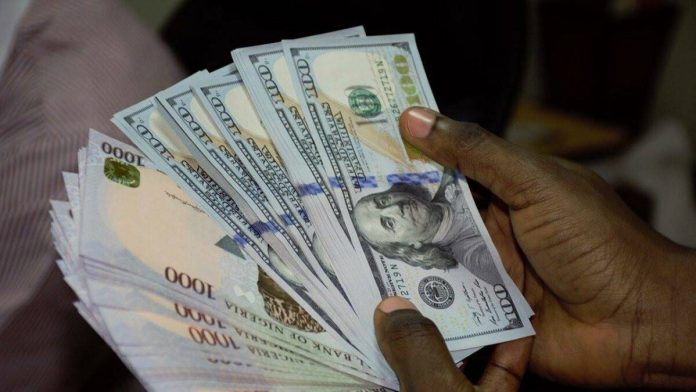
Rising demand for foreign payments at the Nigerian Foreign Exchange Market (NFEM) has pushed the naira lower against the US dollar, prompting fresh intervention from the Central Bank of Nigeria (CBN) to ease pressure.
The latest update from the CBN showed the naira’s official rate weakening to ₦1,530.26 per dollar, down from ₦1,525 the previous day, marking a ₦10 decline over two days as dollar demand for foreign payments increased. Analysts noted that the CBN injected $50 million into the market to stabilise the currency.

At the parallel market, the naira closed at ₦1,535 per dollar, maintaining Thursday’s level as dollar demand remained steady.
FX data from the CBN platform revealed the naira traded at an intraday high of ₦1,535 and a low of ₦1,516 before settling at ₦1,532. The NFEM rate, derived from the Volume Weighted Average Price, serves as the official closing rate for the day, according to CBN guidance.
Despite market pressures, Nigeria’s external reserves continued their upward trend, rising to $37.355 billion, supported by foreign inflows and recent open market operations, even as FX interventions remained limited.
Meanwhile, the global oil market faces a precarious balance in the second half of 2025, with the International Energy Agency (IEA) revising demand growth projections downward to 741,000 barrels per day, well below pre-trade war estimates. Non-OECD countries are expected to drive 86% of this growth, while OECD demand is projected to decline by 120,000 barrels per day due to energy transition policies and economic stagnation.
Zedcrest Research noted that Nigeria’s oil and gas sector outlook for H2 2025 will be shaped by global market headwinds, shifting supply-demand dynamics, and ongoing domestic reforms.
Analysts warn that the reactivation of naira debit cards for offshore transactions could increase FX outflows in the second half of the year, requiring the CBN to strengthen external reserves to defend the naira.
Nigeria’s FX earnings remain exposed to volatility, as oil markets may face moderate oversupply with OPEC+ seeking to regain market share while non-OPEC supply, led by the US and Brazil, continues to expand. This, combined with subdued global GDP growth and a plateauing Chinese economy, creates a challenging environment for price stability.











 has pushed the naira lower against the...)