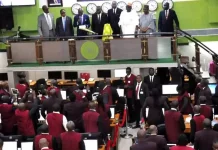
Transactions on the floor of the Nigerian Stock Exchange, NSE, traveled farther north on Monday, March 21, as the All Share Index appreciated by 0.81% today to 25,902.95 points.
Year-to-date (YTD), the NSE ASI depreciated by 9.56%.
The appreciation recorded in the share prices of GT Bank, UACN, Lafarge Africa, Dangote Cement and Zenith Bank were mainly responsible for the gain recorded in the Index. In addition, the share price of United Capital appreciated by 9.41%.
The total value of stocks traded on the floors of The NSE today was N2.07bn, up by 9.27% from N1.89bn last Friday. The total volume of stocks traded was 412.47mn in 3,285 deals.
The three most actively traded stocks were: Zenith Bank (50.05bn), Fidelity Bank (47.62mn) and Afromedia (45.49mn). The most actively traded sectors were: Financial Services (237.61mn), Consumer Goods (59.52mn) and Services (47.52mn).
Trading in equities remained in the Green Zone at the Nigerian Stock Exchange on Monday, March 21, as more investors took position on stocks over excitements of dividend announcements.
The excitement of dividend announcements lifted the equity market as United Capital announced a record dividend of 35kobo per share while Sterling Bank also announced a dividend of 9kobo per share.
The Market Capitalization gained N72 billion to close at N8.910 trillion, compared to the increase of N5 billion recorded on Friday to close at N8.838 trillion. United Capital Plc led the gainers’ table with 16 kobo or 9.41 per cent to close at N1.86 per share, followed by Fidelity Bank Plc with eight kobo or 6.67 per cent to close at N1.28 per share.
Guaranty Trust Bank Plc gained 71 kobo or 4.53 per cent to close at N16.38 per share, while Unity Bank Plc was up three kobo or 4.29 per cent to close at 73 kobo per share.
Law Union Plc rose three kobo or 4.29 per cent to close 73 kobo per share. Conversely, Mobil Plc shed N8.55 or five per cent to close at N162.45 per share, while NASCON Plc dropped 38 kobo or five per cent to close at N7.22 per share. PZ Cussons Plc dipped N1.20 or 4.99 per cent to close at N22.84 per share, while Union Dicon Salt Plc declined 56 kobo or per cent to close at N10.69 per share. Champion Breweries Plc depreciated 15 kobo or 4.81 per cent to close at N2.97 per share.
The Nigeria Customs Service, NCS, said it intercepted 1,263 cartons of poultry products and frozen fish worth over N9.9 million.
The items, concealed in a Volvo truck, were confiscated by the Headquarters Special Assignment Team ‘C’, Ogun State Axis. The team was led by Assistant Comptroller of Customs Shittu Almarof.
The Volvo truck with registration number LND 298 XN was intercepted for random check on the Sagamu-Benin Expressway.
Almarof told said that the occupants of the truck gave themselves away by their suspicious behaviour.
“Therefore, a casual search was conducted on the truck even though the occupants had earlier told the team that the truck was carrying frozen fish.
“The truck was brought down to the headquarters of Federal Operations Unit Zone ‘A’ Ikeja-Lagos, where physical examination confirmed that the truck carried 785 cartons of smuggled frozen poultry products concealed with 478 cartons of frozen fish.
“The Duty Paid Value (DPV) of the items is N9,975,000.
“We are working assiduously and in close collaboration with other anti-smuggling outfits in the zone to deal very decisively with the hydra- headed monster of smuggling. We have the responsibility to complement the effort of allied teams in the Zone in view of the need to frontally tackle smuggling within the South-West and its environ,” he said.
According to the Federal Airports Authority of Nigeria, FAAN, no fewer than 1,300,487 passengers passed through the nation’s airports between September and December 2015.
This is as the agency also declared that aircraft and cargo movements in the country also increased significantly within the period.
The General Manager, Corporate Communications, FAAN, Yakubu Dati disclosed these during an interview with our correspondent at the Murtala Muhammed Airport, MMA, Lagos.
Dati said in September, airports managed by FAAN recorded 316, 680 passengers while the traffic in October was 318, 503.
Also, in November, the nation’s airports recorded 328,652 passengers’ movement while the number slightly increased to 336,652 Dati however attributed the growth to some significant steps taken by the Federal Government in recent time and assured that the traffic would increase astronomically this year.
It would be recalled that a total of 59,233 aircraft landed in all airports across the country in the first quarter of 2015 according to the data released by the National Bureau of Statistics, NBS.
Wema Bank Plc, on Monday, March 21, announced gross earnings of N46.02 billion for the financial year ended December 31, 2015.
This represented a 9.5 per cent rise from N42.19 billion recorded in the same period of 2014.
The earnings rise was attributed to rise in deposit liabilities and robust risk management framework instituted by the lender. The bank also recorded non-performing loan ratio of 2.67 per cent and less than one per cent cost of risk.
Managing Director/CEO, Segun Oloketuyi, who spoke from the Bank’s headquarters in Lagos, said: “Our 2015 performance is a reflection of our resilience and our commitment to continuously deliver value to our stakeholders.”
“The 2015 financial year was a particularly challenging one for the banking sector as the impact of low government spending; policy changes in foreign exchange administration; a depressed energy sector; declining manufacturing outputs and elements of insecurity continued to take a toll on consumer spending and economic activities.”
The bank chief said although these challenges moderated the lender’s performance, it still posted a modest and encouraging result at the end of the 2015 financial year.
Other performance indicators showed that total deposits for the period stood at N284.9 billion, representing a 9.5 per cent increase from the N258 billion recorded in 2014.
The bank’s Profit Before Tax (PBT) closed at N3.04 billion, compared to the prior year figure of N3.09 billion.
Wema Bank was also granted a national banking license by the Central Bank of Nigeria (CBN), which gave it right to establish branches anywhere in the country. The bank celebrated its 70th anniversary with a brand repositioning exercise, which saw it change some core brand elements, giving way to a more vibrant and dynamic look with an increased focus on service excellence.
The National Bureau of Statistics, NBS, on Monday, March 21, stated that the unemployment rate in the country has jumped to 10.4 per cent in the fourth quarter of last year (Q4 2015) compared to 9.9 per cent in the previous quarter.
The NBS noted that a total of 22.45 million of the total labour force of 76.96 million were either unemployed or underemployed in Q4 compared to compared to 20.7 million in Q3 and 19.6 million in Q2.
According to the Unemployment/Underemployment Report for Q4 2015, which was released by the statistical agency, the number of unemployed increased by 518,102 persons, resulting in an increase in the national unemployment rate.
The rate was recorded at 8.2 per cent in Q2 2015.
It further stated that the labour force population-those within the working age population willing, able and actively looking for work- increased to 76.96 million from 75.94million in Q3, representing an increase of 1.34 per cent during the quarter.
According to the NBS, the economically active population or working age population-persons within ages 15 and 64- increased to 105.02 million in Q4, from 104.3 million in Q3, representing a 0.68 per cent increase over the previous quarter and a 3.2 per cent rise when compared to Q4 2014.
“This means 1.02 million persons in the economically active population entered the labour force, that is individuals that were able, willing and actively looking for work,” it added.
Findings have revealed that local carriers operations will spend over N560 billion on aircraft maintenance in 2016.
This amount is expected to cover major aircraft checks in Europe, Asia, America, South Africa, Ethiopia and Morocco.
The checks include “C and D” under which major components of aircraft are stripped and reworked.
According to investigations over 200 aircraft are on the regulatory register for scheduled, private / charter operators and training aircraft.
In 2013, the operators spent over $1.22 billion (N200 billion) when the exchange rate was N200 to $1 on maintenance because of lack of such facility at home.
Nigeria has over 200 aircraft (scheduled, charter and privately owned), which are taken abroad for major repairs. South Africa, Egypt, Morocco and Ethiopia have workable Maintenance Repairs Overhaul (MRO) facilities, and airports that operate as hubs.
The process of taking aircraft abroad for repairs, according to engineers, takes a minimum of two weeks with a corresponding loss of about $500,000 (N160 million) for C-Check on Boeing 737. A smaller aircraft, such as, Embraer 190 or 100 would cost $300,000 (N110 million) during the same period. Many of the airlines take their aircraft abroad for repairs at exorbitant costs.
A former spokesman for Airline Operators of Nigeria (AON), Mohammed Tukur, called for partnership between the government and private investors to establish a local maintenance facility.
According to him, it could save the airlines over 50 per cent of maintenance costs and make Nigeria a technical hub for aircraft maintenance. MRO costs encompass both the outgoing charges and the revenue loss during the out-of-service period.
Nigeria’s President Muhammadu Buhari urged banks to help boost the diversification effort of the Federal Government by increasing its lending to the agricultural sector.
He said this on Monday in Abuja at a gathering of the advisory National Economic Council (NEC) attended by Nigeria’s 36 states governors, the budget and central bank governor. Part of his drive is to encourage diversification away from oil production in Africa’s largest economy.
Buhari also vowed to enhance energy provision in a country long blighted by power shortages.
Nigeria, Africa’s top oil producer, has been hit hard by a fall in crude prices that has cut vital oil revenues – which account for 70 percent of national income – causing the economy to grow by just 2.8 percent in 2015, its slowest pace in decades.
According to Buhari,”Our real wealth is in farming, livestock, hatcheries, fishery, horticulture and forestry,” Buhari told a gathering of the advisory National Economic Council (NEC) attended by Nigeria’s 36 state governors, the budget minister and central bank governor.
“Banks should be leaned upon to substantially increase their lending to the agricultural sector. The Central Bank of Nigeria (CBN) should bear part of the risk of such loans as a matter of national policy,” he said.
Toyota Nigeria Limited has recorded a breakthrough with the unveiling of its first locally-assembled vehicle in Lagos, a Hiace bus.
The Managing Director, Toyota Nigeria, Mr. Kunle Ade-Ojo, said the new Hiace was assembled in the company’s plant in Lagos, built with 30,000-unit production capacity every year. He stated that the plant’s facility comprising two lines is expected to assemble mini buses, pickups and other light commercial vehicles.
Ade-Ojo said, “We need to introduce some changes to the plant so as to achieve efficiency in the operations. With the current economic situation, we are looking at starting the mass production in a couple of months.
“We are constantly training technicians and as far as the plant is concerned, we are assuring customers that we will continuously improve the assembling process of our vehicles to ensure that the vehicles meet international standards.”
The plant, which occupies a 40,000 square metre of land, was built to handle different models.
He said as soon as the mass production of vehicles commenced, there would be competitive prices for its products.
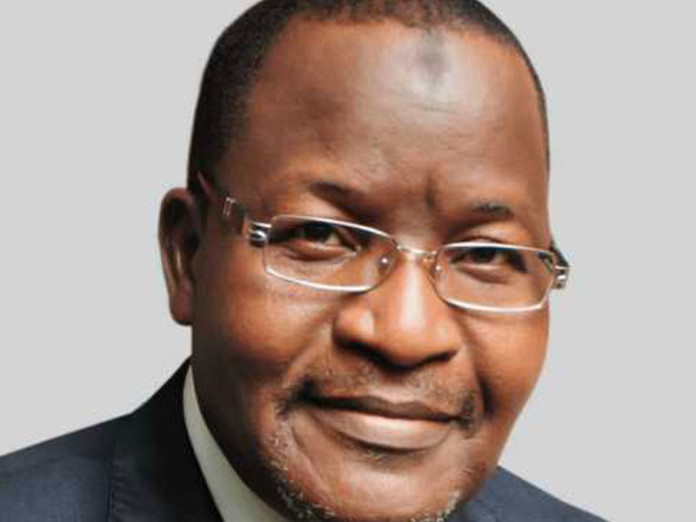
The Executive Vice Chairman (EVC), Nigerian Communications Commission (NCC), Prof. Umar Danbatta, has proposed the use of Information Communication Technology (ICT), to drive the country’s economy.
He assert: “Global oil prices are not favourable and, therefore, what is accruing to Nigeria through oil and gas cannot fund the kind of projects that are targeted at alleviating poverty.
“In sustaining service delivery, I’m sure government in her wisdom decided that there is need to look for other alternative sources of funding and I’ m sure the communication tax bill that government is talking about with consultations ongoing is targeted at finding alternative ways of funding services as captured in the 2016 budget.”
He stated that the plunge in oil prices is indicative that government will rely more on the telecom sector to drive the economy, adding that the sector if well harnessed is capable of contributing more than 10 percent to the country’s GDP.
President Muhammadu Buhari has said that epileptic power supply in the country is no longer a laughing matter.
He said; ”Nigerians’ favourite talking point and butt of jokes is the power situation in our country. But, ladies and gentlemen, it is no longer a laughing matter. We must and by the grace of God we will put things right.
“In the three years left for this administration we have given ourselves the target of ten thousand megawatts distributable power. In 2016 alone, we intend to add two thousand megawatts to the national grid.
“This sector has been privatized but has yet to show any improvement in the quality of service. Common public complaints are, constant power cuts destroying economic activity and affecting quality of life. High electricity bills despite power cuts, low supply of gas to power plants due to vandalisation by terrorists.”
An Aviciation servicing operator, Mr Achuzie Ezenagu ,the Managing Director/ CEO of Toucan Aviation Support Services, has called for Local maintenance of Aircraft.
He called on Federal government and stakeholders in the industry to urgently establish a major Maintenance, Overhaul and Repair (MRO) facility in Nigeria.
Ezenagu lamented that over N15 billion was been spent annually on periodic maintenance of its aircraft overseas.
“In addition to retaining this huge amount of money in Nigeria; the setting up of MRO facility in the country would create thousands of jobs for Nigerians,” he said.
Ezenagu, who made the call at the Nigerian Business Aviation Conference, which ended in Lagos at the weekend, said the establishment of the facility would save Nigeria huge financial resources, help to train and employ indigenous aircraft engineers, make aircraft checks cost effective for Nigerian airlines as well as reinforce Nigeria as a hub in West Africa.
However, Ezenagu observed that establishing an MRO in the country would face challenges, noting that it would be costly because Nigeria does not have the necessary infrastructure to facilitate it. He added that the cooperation of government and industry stakeholders were needed to make it possible.
According to the former Director General of the Nigerian Civil Aviation Authority (NCAA), Dr. Harold Demuren said Nigeria was overripe to have such facility and noted that if 40 per cent of the funds spent on the re-modelling of airport facilities in the last few years was deployed by government to establish the facility, it would have been invaluable for the development of aviation in the country.
Demuren noted that Nigeria loses huge resources maintaining aircraft overseas adding, besides the economic losses, Nigerian trained aircraft engineers cannot secure jobs locally. He also pointed out that for Nigeria to become the West African hub, it must have the MRO facility.
The annual Nigerian Business Aviation Conference is about the development of business aviation, which includes private charter services, cargo operations and others and how they help as catalyst to the nation’s economic development.
Ezenagu who was a panelist at the conference said Nigeria needs to focus on aviation development because it is the fulcrum of the nation’s development.
“We should make the airport more accessible and make them more available. Government can encourage stakeholders to grow the sector by providing incentives. Government should also find a way to bring all the data from different sectors of the economy together because every sector works hand in hand with another.
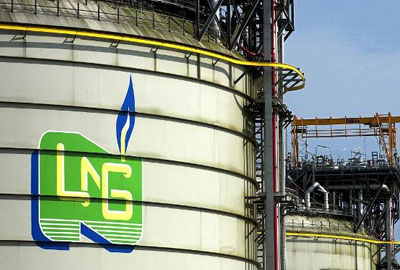
The Nigeria Liquefied Natural Gas (NLNG) Limited will soon be obliged to contribute in the funding of the Niger Delta Development Commission (NDDC).
The Bill sponsored by the House Minority Leader, Leo Ogor, is entitled: “Bill for an Act to Amend the Nigerian Liquefied Natural Gas (LNG (Fiscal Incentives, Guaranteed and Assurances) Act, Cap. N87, Laws of the Federation of Nigeria, 2004 to empower the Nigerian LNG Ltd to make its Statutory Contributions to the NDDC Fund and for Other Matters Connected Therewith.”
The NDDC Establishment Act, specifically section 14 (2)(b) stipulates that three percent of the total annual budget of any oil producing company operating onshore and offshore in the Niger Delta area, including gas processing companies like NLNG, shall be paid into the Funds of the Niger Delta Development Commission.
Ogor noted that apparently the NLNG Limited has not contributed a kobo to the NDDC fund as required by the NDDC Act, 2000 for about 27 years of its operation in the region, despite the huge earnings it has made.
He further stated that the Bill also seeks to prevent a total degradation of the oil-rich Niger Delta region whose environment has extensively been depleted due to oil exploration over the years.
The federal government has urged Nigeria’s field epidemiologists to give priority attention to disease control, community-based surveillance, emergency response and research, as these are pivotal to the long term success in tackling challenges of disease outbreak.
Minister of Health, Prof Isaac Adewole said ‘’ I am focusing on Lassa fever because if we get it right for Lassa fever, we will also get it right for the other communicable diseases whether it is cholera, Cerebrospinal Meningitis (CSM), Influenza, Middle East Respiratory syndrome (MERS-Co) or even Zika Virus.’’
‘’we have to be vigilant all the time. To me this is what should keep the trainees and graduates of the program awake at night thinking about pro-active strategies to deal with these diseases under the leadership of Nigeria Centre for Disease Control,’’ he added.
He assured the epidemiologists of his commitment to support the training programme as well as other capacity building efforts within the Nigeria Centre for Disease Control (NCDC).
The Speaker, Kwara State House of Assembly, Rt. Hon. Ali Ahmad, has pledged the house of assembly’s readiness to support the state government’s drive to improve the state economy through culture and tourism.
He stated that the move would go a long way in enhancing the sector and boost Kwara’s internally generated revenue (IGR) to further enable government meet the yearnings of the citizenry.
Ahmad said, “Without doubt, tourism is one of the key areas that would fetch the state government huge resources and aid development especially in the face of economy hardship being experienced in the country”.
The University of Calabar, has graduated a total of 7,222 students, cutting across various disciplines at its 29th convocation ceremony.
The Vice Chancellor of the university, Prof. Zana Akpagu stated, that the university was the first university in Nigeria to introduce a course in anti-corruption, as part of efforts to support the anti-corruption crusade by President Muhammadu Buhari-led administration.
According to Akpagu, he stated that after a thorough assessment, the graduating students were all found worthy both in character and learning to earn the institution’s certification.
This is 29th convocation, according to him, he stated that it records a total of 7,222 graduating students made up of 4,868 first degree holders, 952 higher degrees and 1,402 diplomas.
The vice also explained further that out of the total number of graduating students, 12 in different disciplines bagged first class, while 1,026 had second class upper degrees.
While complimenting the success recorded so far in the fight against corruption by President Muhammadu Buhari, Akpagu narrated how UNICAL pioneered an anti-corruption course, among Nigerian universities.
He added the initiative was aimed at inculcating in future leaders the virtues of hard work, honesty and patriotism; which will help to reduce corruption in the country.
The vice chancellor said, “Mr. President, your anti-corruption crusade which has earned us accolades both at home and abroad, is worthy of emulation.
He also said that,“We in the University of Calabar have also joined the crusade against corruption; we are the first University in the country to introduce the anti-corruption studies, designed by the Independent Corrupt Practices and other Related Offences Commission (ICPC), for Nigeria Universities.
The Nigerian Electricity Regulatory Commission (NERC) has issued a licence to the Ondo State government and its South Korean partner, Kingline Development Company, to generate 550 mega watts of electricity in the state.
According to the Head of project, Akinnola Fola, the construction of the Independent Power Plant (IPP) would commence in June. He described the development as a major milestone in bringing the first phase of the Kingline Ondo IPP Limited to reality.
However, the state government, had sealed an engineering, procurement and construction (EPC) contract with POSCO E & C of South Korea for the first phase of the proposed1100-mega watt facility.
The phase involves the construction of a gas-fired power plant that would generate 550 MW of electricity to be linked to the national grid. The second is expected to add another 550MW. The project is expected is to be completed in 26 months from the date of commencement and issuance of notice to proceed (NTP).
Petroleum Marketers Association of Nigeria (IPMAN), has hinged the persistent fuel scarcity in the country on the nefarious activities of saboteurs in Nigeria National Petroleum Corporation (NNPC).
According to the Chairman of IPMAN in Kano, Alh. Bashir Dan-Mallam, the incessant scarcity of the products may continue to ground commercial and socio-economic activities of the nation if the activities of the saboteurs are not nipped in the bud.
He insisted that the treacherous cabal in NNPC are bent to resist government reforms, adding that unless the elements are identified and flushed out of the system, challenges in the oil sector may degenerate.
Alhaji Isa Bawa, the Organising Secretary, Rice Farmers Association of Nigeria (RIFAN), revealed that no fewer than 60, 000 rice farmers in Kano State will benefit from the Central Bank of Nigeria’s Anchor Borrowers Programme.
Bawa said the Central Bank of Nigeria (CBN) required no fewer than 100,000 registered farmers before disbursing the fund. He also recalled that the Federal Government inaugurated the programme in November 2015 in Kebbi as part of effort to boost rice and wheat production in the country.
“The CBN has set aside N40 billion for the implementation of the programme in the state. We are trying to register at least 60,000 rice farmers so that the programme can start before the wet season,’’ Bawa said.
He said the association had also discussed with officials of the bank on the implementation of the programme “which is expected to begin between now and May.
“We are expected to have a minimum of 10 farmers and a maximum of 25 farmers in each cooperative.’’
The Emir of Kano, Muhammad Sanusi II, is made chairman for the grand finale of the University of Lagos Muslim Alumni’s (UMA) 30th anniversary, which will hold on Sunday, April 17, at the Grand Ball Room, Eko Hotel & Suites, Victoria Island, Lagos.
Alhaji AbdulMumini Alao is the planning committee chairman, said that the event would feature the launch of a N150 million Scholarship Endowment Fund.
He said the Minister of Power, Works and Housing, Mr Babatunde Fashola, would deliver a keynote address on “Nigeria: Strategies for a sustainable economy.”
Other special guests expected at the event include South-West governors; Lagos State deputy governor, Dr Idiat Adebule; Oba Rilwan Akiolu of Lagos; MD/CEO, Sigma Pensions Limited, Alhaji Umaru Modibbo; Vice Chancellor, University of Lagos, Professor Rahaman Bello; Alhaji Aliko Dangote; Mr Biodun Shobanjo of Troyka Holdings; Alhaji Tajudeen Owoyemi of Protea Hotel, Ikeja, Alhaja Wonuola Folami, among others.
Alao also said post-humous merit awards would be conferred on former Baba Adinni of Nigeria, Alhaji Wahab Iyanda Folawiyo; former Aare Musulumi of Yorubaland, Alhaji Azeez Arisekola Alao and Alhaji Rasheed Oyekan.
He said plans were on to visit to Bab Es-salam Orphanage in Ikeja; Modupe Cole Orphanage at Akoka; Federal Prisons in Ikoyi, Lagos, as part of activities for the anniversary.