The Federal Government is set to establish weigh-stations at the nation’s seaport to beat the deadline of the new International Maritime Organization, IMO, law that makes it compulsory for all consignment meant for export to be weighed before leaving their port of origin.
The law is expected to take effect from the 1st of July, 2016.
A senior staff in the ministry of transportation, who revealed this to Vanguard in Abuja, said that government is considering whether to construct the weigh-stations directly before concessioning them or construct them on a Public-Private Partnership basis.
The source said that they are expecting a recommendation to that effect from the Nigerian Shippers Council, NSC, at the end of the just concluded workshop themed, “Transport cost and regional connectivity of African countries.”
The NSC official said that they also considered the option of allowing terminal operators to handle the weighing of such consignments but reasoned that the terminal operators may use it as a means of further exploiting Nigerian shippers.
An alarm was on Wednesday, March 23 raised by the Organized Labor over the imminent job loss in the food, beverage and tobacco sector of the nation’s economy.
It said over three million jobs were at risk due to the inability of companies to source foreign exchange to import raw material for operations.
Already, leading companies in the sector, such as Nigerian Flour Mills, Nigerian Breweries Limited, Guinness Plc, Nigerian Bottling Company, 7-UP Bottling Company Plc, Friesland Campina Wamco Plc, among others, have written to labour for discussions on retrenchment of workers.
In the last three months, no fewer than 1,500 workers had been sacked in the sector as employers seek ways of coping with foreign exchange crisis, among other challenges.
At a briefing in Lagos, leaders of Food, Beverage and Tobacco Senior Staff Association, FOBTOB, called on government to intervene to save the industry and over three million jobs.
President of FOBTOB, Quadri Olaleye, claimed that employers in the sector had devised every opportunity to sack workers, adding that between the 2012 and the first half of 2015, over 3,000 workers were sacked in the guise of re-engineering, restructuring, right sizing, downsizing, redundancy and re-organisation.
He lamented that over the years, the same excuse of difficult business terrain, dwindling profit, irregular and insufficient power supply, and so on had been given.
He said: “The current situation has reached a pathetic level, because it seems all the employers in our sector are in competition with each other on who can lay off the most workers.
“Every company is now calling for a downsizing of the workforce, and this time under the guise of lack of foreign exchange due to the Federal Government’s recent policy on foreign exchange.”
The Lagos and Kebbi State Governments, on Wednesday, March 23, signed a memorandum of understanding (MoU) which they said would see to the production of 70 per cent of Nigeria’s rice requirements yearly.
The agreement was sealed at the State House, Alausa, Ikeja, Lagos wednesday by the Lagos State Governor, Mr. Akinwunmi Ambode, and his Kebbi State counterpart, Alhaji Atiku Bagudu, along with representatives of the two governments.
The signing of the MoU was witnessed by members of the State Executive Council from the two states, representatives of the two Houses of Assembly, leaders of All Progressives Congress (APC), traditional rulers, community leaders among others
The agreement, which principally centres on boosting the production of wheat, ground nut, maize, millet, sorghum, sugar cane, cows among others, was the first state-to-state relations in the country.
Before signing the agreement, Bagudu unequivocally disclosed that the goal of Lagos-Kebbi partnership on food production was “to produce 60 to 70 per cent of Nigeria’s rice needs, and replicate same in other food items.”
He therefore explained that in the world of genetically modified food, the partnership between Lagos and Kebbi States was an additional motivation to provide certainties for the people in terms of food production and sufficiency.
Bagudu noted that both states “have had a long history of trade, and that the signing of the MoU was another way of cementing the relationship with the view to making the people get richer. Lagos is the most entrepreneurial part of Nigeria.
“Lagos, if it were a country itself, is a country that other states will be going to establish a relationship with, and so why not state to state. So, what we are doing is to pioneer a collaboration that will bring other states on board later as we believe that our potentials are enormous, and we must have pacesetters to start that process of joint collaboration for our collective good.”
Giving an insight into the signing of the agreement, Ambode acknowledged that the ceremony was to formalise an agreement between Lagos and Kebbi States “to enter into a partnership for food processing, production and distribution.”
Trading activities on the Nigerian Stock Exchange, NSE, on Wednesday, March 23, resumed southward movement with the market indices plunging by 1.09 per cent, reversing the four-day growth.
The All-Share Index lost 283.40 points or 1.09 per cent to close at 25,736.92, compared with the 26,020.32 recorded on Tuesday, March 22.
The plunge was attributed to the value depreciation recorded in the stocks of FBN Holdings, Total Nigeria, Mobil, Zenith Bank, Dangote Cement, GT Bank and Lafarge Africa.
Mobil Oil recorded the highest loss, to lead the losers’ chart with a loss of N7.54, to close at N154.91 per share.
Total trailed with N7.49 to close at N142.46, while Dangote Cement depreciated by N4 to close at N164 per share.
Guinness lost N3.07 to close at N108.93 and Seplat dropped by N3 to close at N308 per share.
Conversely, Nigerian Breweries led the gainers’ table, increasing by N4.41 to close at N113.61 per share.
Vitafoam followed with a gain of 20k to close at N4.30, while NAHCO gained 19k to close at N3,99 per share.
Oando increased by 9k to close at N4 and Fidelity Bank appreciated by 6k to close at N1.40 per share.
United Capital emerged the most active stock, exchanging 95.96 million shares worth N199.62 million.
Access Bank followed with an exchange of 60.75 million shares valued at N239.84 million and Multitrex traded 40 million shares worth N20 million.
The FCMB Group sold 38.13 million shares worth N29 million and Zenith Bank transacted 28.68 million shares valued at N356.49 million.
In all, a total of 398.28 million shares worth N2.65 billion were exchanged by investors in 3,581 deals.
NAN reports that this was against the 344.12 million shares valued at N2.46 billion traded in 4,386 deals on Tuesday. (NAN)
Nigerian bond yields jumped across the curve on Wednesday, March 23, after the central bank unexpectedly tightened monetary policy in an effort to attract foreign investors.
The Central Bank of Nigeria, CBN, yesterday spiked its benchmark rate to 12 per cent from 11 percent, having cut rates only four months ago by 2 percentage points, and lifted the cash reserve ratio for commercial banks to 22.5 per cent from 20 per cent.
Yields on the benchmark 20-year bond climbed 55 basis points (bps) to 12.7 per cent while the 10-year yield climbed 45 bps to 12.65 per cent. The yield on five-year paper, the most liquid maturity, gained 41 bps to 11.7 per cent.
CBN governor Godwin Emefiele, said extra liquidity had not translated into more lending and cited inflation, at a 3-1/2-year high of 11.4 percent last month, and well above the central bank target of 6 per cent to 9 per cent.
Activities at the Nigerian Stock Market on Wednesday, March 23, were characterized by series of losses as profit taking resurfaces.
The market capitalization shed N97 billion or 1.09 per cent to close at N8.853 trillion, as against the N8.950 trillion achieved on Tuesday.
Market analysts attributed the slide to profit taking embarked upon by some investors, due to a hike in the Monetary Policy Rate (MPR) to 12 per cent from 11 per cent.
They stated that the dip was impacted by value depreciation recorded in the stocks of FBN Holdings, Total Nigeria, Mobil, Zenith Bank, Dangote Cement, GT Bank and Lafarge Africa.
Mobil Oil recorded the highest loss, to lead the losers’ chart with a loss of N7.54, to close at N154.91 per share.
Total trailed with N7.49 to close at N142.46, while Dangote Cement depreciated by N4 to close at N164 per share.
Guinness lost N3.07 to close at N108.93 and Seplat dropped by N3 to close at N308 per share.
Conversely, Nigerian Breweries led the gainers’ table, increasing by N4.41 to close at N113.61 per share.
Vitafoam followed with a gain of 20k to close at N4.30, while NAHCO gained 19k to close at N3,99 per share.
Oando increased by 9k to close at N4 and Fidelity Bank appreciated by 6k to close at N1.40 per share.
United Capital emerged the most active stock, exchanging 95.96 million shares worth N199.62 million.
Access Bank followed with an exchange of 60.75 million shares valued at N239.84 million and Multitrex traded 40 million shares worth N20 million.
The FCMB Group sold 38.13 million shares worth N29 million and Zenith Bank transacted 28.68 million shares valued at N356.49 million.
In all, a total of 398.28 million shares worth N2.65 billion were exchanged by investors in 3,581 deals.
NAN reports that this was against the 344.12 million shares valued at N2.46 billion traded in 4,386 deals on Tuesday. (NAN)
State officials have stated that the Federal Government is owing 16 states of the federation the sum of N580.5bn, which was incurred as a result of various rehabilitation works carried out on some federal roads across the country.
The disclosure was made on Wednesday, March 23, in Abuja at a public hearing organized by the joint House of Representatives committee on works and finance.
Giving the breakdown of the funds owed Ogun State, the permanent secretary in the state ministry of works and infrastructure, Engr. K. A. Ademolake, disclosed the state government had awarded 38 contracts for the construction of the federal roads in the state from 2007 to date.
He said out of the total sum, the state government had paid the sum of N123.7bn to the contractors.
He added that there was no single reimbursement from the federal government.
Leading the states owed are Ogun, Akwa Ibom and Zamfara states being owed the sum of N222.977bn, N75.9bn and N57.92bn respectively.
Other states being owed are Anambra State with N43.427bn; Oyo State, N32.93bn; Enugu State, N25.930bn; Cross River State, N25.701bn; Ebonyi State, N21.85bn; Plateau State, N19bn; and Sokoto State, N13.103bn.
Also owed are Kwara State, N12.855bn; Ekiti State, over N11bn; Abia State, N5.2bn; Adamawa State, N4bn; Gombe State, N3.851bn and Bauchi State, N1.9bn.
The Korea International Cooperation Agency, KOICA, has earmarked $8.56 million for the implementation of an e-government project comprising establishing an e- Government master plan, capacity development programme (CDP) and establishing an e- Government training centre in Nigeria.
Minister of Communications, Barrister Adebayo Shittu has said the collaboration with the Korean Government will enhance Nigeria’s capability for efficiency, transparency and accountability in governance, with its attendant benefits trickling down to the masses.
The Minister led a 14-man delegation to this year’s 10- day high level capacity building for e-Government in Nigeria benchmarking invitational programme, in Seoul, South Korea yesterday. The invitational programme, designed for senior government officials was put together by KOICA.
According to a statement by the minister’s special assistant on media, Victor Oluwadamilare, the expectations of Shittu is geared towards ensuring that Nigeria makes the best use of the opportunity of e- Government to increase the nation’s capability for efficiency, transparency and accountability in governance.
The Nigerian Customs Service, NCS, Zone A, Command, Lagos, has revealed that the federal government is presently losing billions of naira to fraudulent shipping companies involved in the midstream discharge of cargoes.
The NCS alleged that some dubious shipping companies were involved in the mass discharge of cargoes midstream in order to avoid paying duties to government.
Though it did not name the shipping companies involved in the sharp practice, it however solicited the assistance of naval authorities to check the activities of those allegedly involved in the practice.
The Zonal Coordinator, Zone ‘A’ of the NCS, Assistant Comptroller-General Eporwei Edike, who made this disclosure when he paid a courtesy call on the Flag Officer Commanding Western Naval Command, Rear Admiral Raphael Osodun, urged the Nigerian Navy to assist the Customs in stopping midstream discharge of cargoes.
He said: “We have to look at other sister agencies to assist us to succeed in our duties.”
Investigations have revealed that marketers are selling Household Kerosene, HHK above the approved pump price of N84.17 per litre.
They sell the product for between N115 and N120 per litre.
According to the Petroleum Products Pricing Regulatory Agency’s (PPPRA) pricing template of March 17, the expected open market price (OMP) of kerosene is N84.17 per litre.
However, marketers, mainly independents, sell the product well above the approved price of N84.17 per litre. In many retail outlets in Lagos, The Nation discovered that consumers buy kerosene at N120 per litre.
At some retail outlets in Ikotun, Egbeda, Idimu, Iyana-Ipaja, and Agege in Lagos, consumers stood in long queues to buy the product, described as “poor man specific”. Those who went to the Nigerian National Petroleum Corporation (NNPC) outlets to buy at cheaper price, were disappointed as the product was not available.
Contacted, Independent Petroleum Marketers Association of Nigeria (IPMAN) National President, Chinedu Okoronkwo said he was not aware that his members were selling kerosene above the official price.
He said the association would deal with any of his members who sells the product above the official price of N83 per litre, adding that the association is yet to arrest anybody in that regard.
New restriction order has being placed on the importation of rice through land borders across the country by the Comptroller-General of the Nigeria Customs Service, Col. Hameed Ali (Retd). This order comes into effect immediately.
Col. Hameed Ali had last October authorized the turnaround of an earlier policy banning rice imports through the land borders, saying once the suitable duty and charges had been paid, importers were free to bring in the produce.
On Tuesday , The Public Relations Officer, NIS, Wale Adeniyi, Stated that the Service had noted that decaying revenue from rice imports through the land borders, did not match the volume of the produce landing in neighbouring ports.
According to him, reports from the border instructs, display an increase in the tempo of rice smuggling.
“The implementation of the restriction order got off to a smooth start, with a high level of compliance in October 2015. However, revenue started decreasing from January 2016, with importers blaming access to Forex as major hindrance,” Ali said.
Ondo State Governor, Dr Olusegun Mimiko, has revealed that his administration had spent about N3 billion to refurbish and upgrade various water projects in the state while an additional N1.2 billion was spent on sinking of water boreholes since the administration came on board in 2009.
He added that the administration awarded contracts for water scheme in Ilaje Local Government area of the state at a sum of N4.3 billion last year.
Mimiko uncovered some of the expenses of the administration for the provision of water in Akure at an event to mark the World Water Day, which has as its theme, ‘Water and Work”.
He said the N3 billion was spent on the rehabilitation and upgrade of Awara Water Scheme, Ose-Owo Water Scheme, Ifon Spring Water Scheme adding that those boreholes sank had been handed over to WATSAN for maintenance.
The Adamawa State government is set to boost food production and ensure food sufficiency in the state through mechanized farming.
The State Commissioner of Agriculture Waziri Ahmadu, noted that his ministry will revamp the state’s feeble Agricultural Mechanization Authority.
He explained that when he came on board as the commissioner of agriculture, he inherited worn-out tractors, adding that his ministry is making serious effort to resuscitate a number of tractors and other equipment to meet the current challenges.
Ahmadu stated that in 2015, the ministry only provided about 3,000 hectares of mechanization, adding that the ministry is strenuously working to provide between 80,000 and 100,000 hectares of mechanization in 2016.
To commemorate the 2016 Financial Literacy Week held last week, Unity Bank Plc, took its financial literacy campaign to Supreme Model Foundation, Lagos. The financial literacy week is observed annually under the Global Money week and it is recognized as part of efforts to establish and sustain healthy financial habits among children.
Mr Olubowale Ogunrinde, GM/Zonal Head Lagos and South West, Unity Bank Plc, said the initiative was aimed at equipping children across the country with information on how to be financially independent using training materials that touched on topics in the area of savings, investing, budgeting inflation and insurance.
He stated that learning about these areas will not only broaden the understanding of the children on financial systems but also teach them how to imbibe the culture on financial management at a young age.
The Vice Principal of Supreme Model Foundation, Mr Olufemi Adeyemi thanked the Bank for facilitating the lecture at the school.
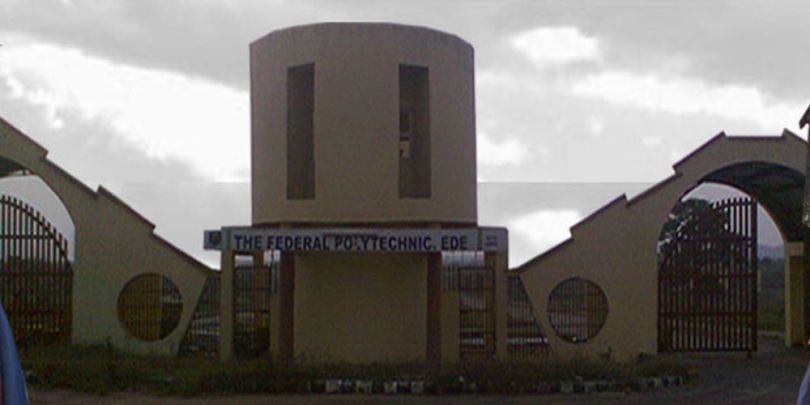
There was a peaceful protest staged by academic staffs of the Federal Polytechnic, Ede, Osun State, on Tuesday controlled by enraged students who closed the main enterance to the campus of the institution for several hours.
Lecturers were asking the management of the institution full implementation of new welfare package tagged CONTISS 15, contending that other institutions had paid it to their colleagues.
The lecturers were said to have given the management 14-day ultimatum within which to effect the payment or face the wrath of the workers. The ultimatum lapsed on Monday, prompting them to state the protest by the lecturers.
The protest later turned violent when some students the polytechnic hijacked and dominated the entrance of the polytechnic.
However, the students, who had just started their exams on Monday, abandoned their classes and joined their teachers kicking against payment of N1,000 for late registration.
The Minister of Science and Technology, Mr. Ogbonnaya Onu, has attributed the collapse of Nigeria’s automobile and other industries to the absence of research and development.
He said that there is no reason Nigeria’s auto industry should not be strong enough to survive external competition, with the highest population, largest economy and market in Africa
Onu said: “I think that was where Peugeot Automobile of Nigeria (PAN), failed and all the other industries. So as soon as there was competition from outside, all these companies collapsed and we believe that we have to learn a lesson from this. “
“If you look at what happened in 1980s and 1990s it is very clear to us that if our automobile industry had done research and developmental work for a period of time we would have been strong enough.
“Even when government opened up the sector to competition from outside, because government will not to hover forever they would not want to stop competition from outside.”
He said government will not fail in supporting and encouraging local industries to thrive, adding that the ministry will lead the push for the patronage of Made in Nigeria Products.
Dr. Harold Demuren, a former Director-General of Nigerian Civil Aviation Authority, has stated that Nigeria is due for the improvement of aircraft maintenance facility.
He noted that Nigeria had missed extremely large resources of maintaining its aircraft overseas. For example, he said, besides the economic loss, Nigerian experience aircraft engineers could not secure jobs locally.
According to him, about 40 per cent of money used on the reconstructing of airport facilities in the last few years was expanded for that purpose by government, it would have been priceless for the growth of aviation in the country.
He also made a yelled statement at the Nigerian Aviation Conference in Lagos, suggesting that if Nigeria must take its place as the West African center in aviation, it must have its aircraft maintenance facility.
The Managing Director, Toucan Aviation Support Services, Achuzie Ezenagu, called on the Federal Government to focus on the growth of the aviation sector as a catalyst for economic growth.
However, Ezenagu suggest that the establishment of the facility would save the country’s large financial resources, help to train and handle native aircraft engineers, make aircraft profitable for airlines and strengthen Nigeria as the main point in West Africa.
He also noticed that the development of an MRO could be demanding and expensive because Nigeria had no foundation to promote it.
In finalizing this, MRO is very expensive to establish in Nigeria because of the heavy burden from government, but this can be settled.
The federal government has urged health professionals to cease from continual industrial action which has now become a usual occurrence in the health sector, adding that labour disputes are better resolved through dialogue rather than strike and violence.
The Minister of Health, Prof. Isaac Adewole said that incessant labour disputes have been ravaging health sector despite effort made by the present administration to revive the healthcare system.
“Health sector is one of the essential services that are prohibited by law from embarking on strike action. However the Ministry of Health has been subjected to so much ridicule and embarrassment as a result of frequent strikes by the different professionals that make up its work-force”
Adewole warned that henceforth any staff who chooses the path of strike in enforcing his/her demand should not be paid salaries and allowances within the period of strike.
“In order to revert to path of decency and discourage impunity, all Chief Executive Officers of agencies and hospitals under the supervision of the ministry are to strictly, enforce the No Work No Pay Policy.
The Head of Department, Securities and Investment Services (SEC), Mr Abdulkadir Abbas has revealed that investment in real estate in Nigeria would rise from $9.16 billion in 2015 to $13.65 billion in 2016 according to Price Waterhouse Coopers (PwC) report of 2015.
Abbas made this known in Abuja at a 2-day intensive workshop for Real Estate Developers, organised by Real Estate Developers Association of Nigeria (REDAN) in collaboration with Centre for Housing Studies University of Lagos, Housing Programme on AIT Abuja and Housing Time on Raypower with the theme, “Real Estate Value Chain Enhancement for Increased Economic Growth Inclusiveness and Employment Generation “.
He also noted that real estate was one of the fastest growing sectors contributing 7.5% to GDP.
However, he highlighted the growing middle class demand for residential property which has resulted in propelling retail, industrial and commercial real estate development.
“Housing is not only a basic necessity that affects the welfare of the citizenry but also a critical sector of an economy, so a viable and sustainable housing finance plan is essential,” he said.
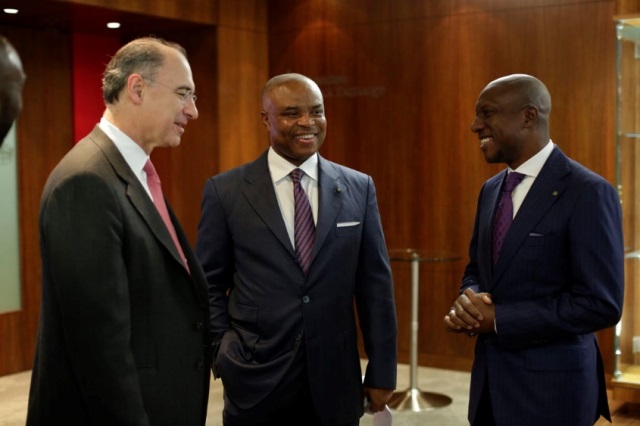
(L-R) Xavier Rolet, Chief Executive, LSE; Dr. A.B.C Orjiako, Chairman, Seplat Petroleum and Oscar Onyema,CEO,(NSE)
Dr. ABC Orjiako, Chairman of Seplat Petroleum Development Company, was selected to join a 12-man team inducted by the London Stock Exchange (LSE) into its Africa Advisory Group.
The Seplat Chairman was inducted in London by LSE Chief Executive, Xavier Rolet with his Nigerian counterpart, Oscar Onyema in attendance.
Dr, Orjiako is the sole Nigerian in a group of African business leaders that would function as an advisory body to the London Stock Exchange.
The African Advisory Group would be expected to come-up with a collaborative leadership study that would deliver to Africa, specific policy recommendations.
It would also be expected to provide a regular forum that would focus on trends and challenges of business operation format within the continent and also troubleshoot problematic issues that affect it from a commercial and social perspective, while helping to boost capital market development.
Also expected of the group: It would serve as a bridge between the London Stock Exchange and African capital markets that has received the endorsement of the United Kingdom government.
Seplat Petroleum is an independent indigenous Nigerian upstream exploration and production company with a focus on Nigeria and its shares are daily traded on the floors of the Nigerian Stock Exchange.