A Peoples Democratic Party’s (PDP) Senator and chairman of the Senate Committee on Niger Delta Affairs, Peter Nwaboshi has boasted that his party would replace Bukola Saraki as Senate President if members of the All Progressive Congress (APC) succeeded in their plans to ease him out of office.
Political watchers had posited that, some APC members were determined to punish Senator Bukola Saraki, who defied the party’s directive to step down for another party member as the senate president, but rather went through the back door to win the seat.
They averred that Bukola Saraki’s ongoing trial at the Code of Conduct Tribunal might have provided a window for them to unseat him.
Meanwhile Nwaboshi boasted, the PDP was ready to replicate the current system in the United States (U.S.) where the Republican Party was in charge of the parliament, while the Democrats controls executive.
He said, “Well, I wish All Progressives Congress (APC) the best of luck if they are making that wild goose chase, but I want you to mark what I’m saying, I was the first to address the press in Port Harcourt and I told them that Saraki was going to win the Senate Presidency, I gave them my reasons. Then, nobody ever thought that Saraki was going to win. People were saying that APC had decided. But it was clear to me that he was going to win and I had to address the press.”
Adding that,“If anybody is thinking that a PDP man is going to vote against a PDP candidate, he is telling you a lie. We have people and we know how to get the people from APC. We will win and that will be very interesting. What is happening in America is going to happen in Nigeria. America has a Republican Senate but the executive is led by Democrats. So, it’s happening in different parts of the world. I can tell you with what’s on the ground that we will produce the next Senate President.”
“The man (Saraki) is going to court and he is obeying the court order. Until it is proven that he is guilty, no amount of blackmail will make us shift our ground and our support for him. In any case, my party, the PDP, we have resolved in our meeting to support him. So, there is no basis for him to resign,” Nwaboshi concluded.
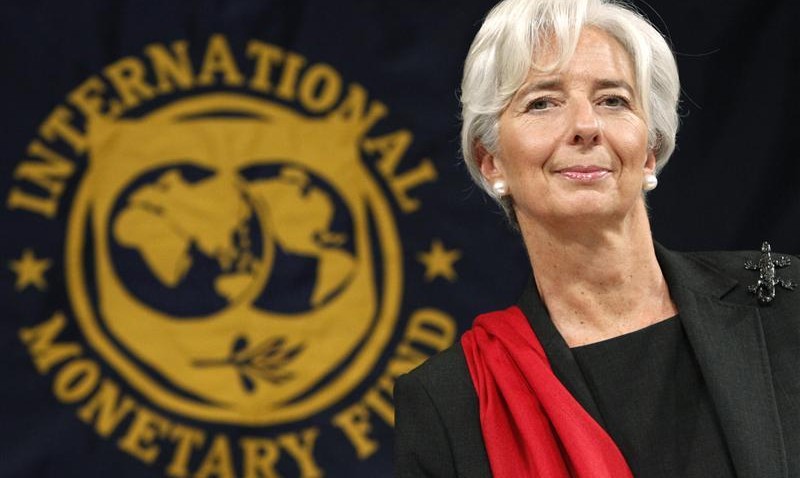
Christine Lagarde Announces Resignation as IMF Chief
The International Monetary Fund (IMF) has again dropped its 2016 forecast on Nigeria’s economic growth, saying the nation was faced with “substantial challenges” caused by low crude prices.
IMF officials, during a visit to the country in February, had forecast a 3.2 percent growth, but its annual review of Nigeria’s economic situation released on Thursday forecast 2.3 percent gross domestic product growth in 2016 from an estimated 2.7 percent in 2015.
“Key risks to the outlook include lower oil prices, shortfalls in non-oil revenues, a further deterioration in finances of state and local Governments, deepening disruptions in private sector activity due to constraints on access to foreign exchange, and resurgence in security concerns,” the IMF said in a statement.
It added that Nigeria’s general government deficit would grow further after doubling to 3.7 percent of GDP in 2015.
The IMF executive board said Nigeria needed to urgently implement policies to safeguard fiscal sustainability, reduce external imbalances and advance structural reforms that promote more inclusive growth.
“Directors emphasized the critical need to raise non-oil revenues to ensure fiscal sustainability while maintaining infrastructure and social spending,” the IMF said. “They urged a gradual increase in the VAT rate, further improvements in revenue administration, and a broadening of the tax base.”
Discussions between Nigeria and the World Bank are continuing on a possible loan or credit facility tied to policy reforms in the West African oil exporter, a spokesman for the Washington-based multilateral lender disclosed.
Forte Oil is an indigenous petroleum marketing company with structured operations and strategic policies to continuously improve product delivery to its customers. Forte Oil is renowned for her ability to offer her consumers a wide range of products from the oil value chain; PMS, diesel, aviation fuel, kerosene, commercial gas and a wide range of lubricants for various automobiles and machines. A major player in the downstream sector of the Nigerian oil and gas sector, Forte Oil prides itself on delivering prompt, quality and effective services to our customers nationwide.
We are recruiting for the position of:
Job Title: HCA Officer
Location: Lagos
Reports To: HCA Advisor
Job Band: TBA
Purpose Statement
To contribute to the implementation, coordination and provision of an efficient administrative support to the delivery of the Human Capital strategy which is aligned with the business objectives of Forte Oil.
Key Accountabilities
Provide Human Capital administrative support to all employees in the assigned business units.
Work with line managers to deliver agreed recruitment and training plans required by the assigned functions.
Monitor and verify that departmental records are stored in compliance with the company’s’ record management policy.
Provides support in ensuring that performance Objectives processes for all assigned business units’ employees are aligned with company objectives.
Implement Human Capital employee service function across all business units including but not limited to managing documentations on Medical, Leave administration, Confirmation, Records management etc.
Collate reports/feedback on Human Capital processes e.g. recruitment, data sheet information on monthly basis on new employee resumption, disciplinary hearings, re-designation, transfer, salary increase, exits, training plans etc.
Provide support through the use of the HRIS to significantly enhance the effectiveness of the Human Capital process.
Support functional units in ensuring units compliance to Human Capital policies and procedures.
Knowledge, Skills and Experience
The position requires an HR professional with a first degree in social science or similar field and at least 2 years work experience in a relevant role.
The incumbent needs to be able to think strategically and be able to find solutions to address the unique needs in the company.
The following skills are essential:
Ability to work with extremely confidential and sensitive data.
Good interpersonal and communication skills.
Good computer skills.
Active member of at least one relevant professional body.
Sound knowledge of oil and gas industry/downstream sector.
Working Relationships:
Internal: The Human Resources team, All assigned business units’ staff, Other internal colleagues in other functional areas across all locations
External: Service providers
Application Closing Date
7th April, 2016.
How to Apply
Interested and qualified candidates should send their CV’s with subject: ‘HCA Officer-FO/HCA/SD/0316 to: external.careers@forteoilplc.com
Red Media Africa (RED) is Africa’s leading omni-media company with a focus on the youth. We are a network of premium media companies including YNaija.com with a prominent development affiliate called The Future Project, owners of The Future Africa Awards & Summit.
At RED, our greatest advantage is our people. #Team RED has a relentless spirit, always pushing the boundaries of what is possible in Africa’s media space. A job at RED is unlike anything you’ve ever seen. You’ll be challenged. You’ll be inspired. You’ll do things you never thought you could. And you will be INCREDIBLY proud of yourself! If you are passionate about the media, how it can empower and drive the conversation, and how we can change the world.
If you’re ready to do the heavy lifting, work incredibly hard and for you it’s greatness or nothing, no matter how tough it gets? Well, we’re constantly looking for people like you! Join us, explore the unlimited possibilities. We are expanding our team again for some exciting new project and client. Hence, we are recruiting to fill the following positions below:
WTS Energy provides recruitment and manpower services for the global oil and gas and energy industries. We supply engineers and consultants to our clients’ projects and operations, and perform employment outsourcing services such as workforce management in oil and gas regions around the world. WTS Energy operates globally with offices in 14 countries and is operational in over 50 countries.
We are recruiting to fill the following vacant positions:
Etisalat’s vision is a world where people’s reach is not limited by matter or distance; a world where people will effortlessly stay in touch with family and friends; a world where businesses of all sizes can reach new markets without the limitations of distance and travel.
We are recruiting to fill the following vacant positions below:
For the first quarter of 2016, stock trading on the Nigerian Stock Exchange, NSE, slid by 13.2 per cent as market capitalization for the first quarter closed at N8.704 trillion against the N9.850 trillion it opened with in January.
This is even as the All Share Index, ASI, also shed 3,336.03 basis points to close at 25,306.22 compared to 28,642.25 basis points it recorded at the opening of trading for the year 2016, as the Year-to-Date (YTD) returns currently stands at -11.65 per cent.
At the end of close of trading activities yesterday, the market however recorded 0.64 per cent gain with the ASI closing at 25,306.22 basis points compared to 25,145.28 points recorded in the preceding trading day.
Similarly, Market Capitalisation added N55.4bn to close at N8.7 trillion compared to N45 billion lost previously to close at N8.69 trillion.
A total of 264 million shares amounting to N1.94 billion were exchanged at the market in 3,298 deals today, with top three traders recorded as FCMB which sold 44.4 million shares worth N38.1 million, Fidelity Bank with total sales of 34.8mn shares amounting to N46.24 million and Sterling Bank transactions of 32.43 million shares valued at N52.5 million.
The day’s index appreciation is attributed to the increase in share prices of Total Plc which rose by N7.32 to close at N153.82 per share, Mobil which also increased by N5.99 to close at N161.99 per share, Dangote Cement’s appreciation of N3.75 to close at N167.8 per share, Julius Berger Plc addition of N3.3 to close at N44.8 per share and 7up’s growth of N2 to close at N155 per share.
Top five financial decliners during the day’s transactions were SEPLAT which lost N10 to close at N300 per share, WAPCO dropped N2 to close at N77 per share and Okomuoil fell N1.57 to close at N29.85 per share. Guinness also lost N1.25 to close at N104.5 per share while Unilever declined by 25 kobo to close at N29 per share.
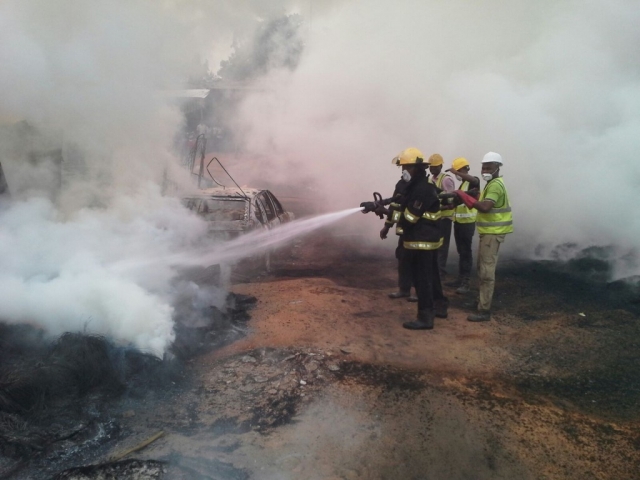
The National Association Nigerian Traders, NANTs, has revealed that the nation has lost over N5.3trillion to fire incidents in the last seventeen years .
The association’s National President, Ken Ukaoha, who disclosed the figures during a media interaction on the incessant fire outbreaks in Abuja on Thursday, March 31 , said it was worrisome that the nation had also recorded over 10 major market fires in the last three months.
Ukaoha pointed out that in all the instances, all state authorities could do was to offer sympathy visits and pronouncement of support, which never saw the light of the day.
He noted that it was ironical that government could be wooing foreign investors into the country all in a bid to improve Foreign Direct Investment (FDI) inflows, without sparing a thought about thousands of small businesses in the country that are being ruined by incessant fires.
The NANTs boss said:”It is rather sad and unfortunate that while successive Nigerian governments have continued to chase Foreign Direct Investments even with tax incentives and other attractions, the local traders who constitute the largest domestic investors in the country are neglected while their investments are left to wither away through fire.
“The consequence of this neglect is that Nigerian traders, and by extension the Nigerian economy has lost over N5.3trn to market fires between May 1999 and March 2016.”
“Yet, more annoying is that no government in power has either deemed it necessary to investigate or take actions to forestall further losses occasioned by market fires. Worst still is that the government that enjoys collection of taxes from the traders would never have ‘compensation’ in her dictionary for the affected traders when such market fires occur.”, Ukaoha added.
The Centre for the Study of Economies in Africa, CSEA, has projected a modest growth in Nigeria’s foreign reserves if the global oil market sees further recovery.
The policy research organization, which made the projection in its latest edition of its Nigeria Economic Update released Tuesday, hinged the positive outlook on the easing market conditions in the international crude market.
According to the Centre, while sundry measures being put in place by the government, including the directive to EFCC to investiage cases of forex speculation, to ensure improved management of the foreign exchange market and by implication, help to stem the decline in the value of the naira on account of speculative demand may not be unjustified, the imperative of having a well-designed framework cannot be under-estimated.
It stated: “While these temporary ad hoc measures can limit volatility in the forex market in the shortterm, a well-designed framework is required to manage the forex market within the medium and long term. Given the sustained increase in the price of crude oil in the period, the foreign reserve increased slightly by 0.14 percent ($35 million), from $27.84 billion to $27.88 billion.
“With easing market conditions in the international crude market, a modest growth in Nigeria’s foreign reserve is expected to continue, at least in the near term”, the CSEA added.
Trading activities on the floor of the Nigerian Stock Exchange, NSE, bounced back into the Green Zone on Thursday, March 31.
The All-Share Index closed higher at 25,306.22 indicating an increase of 160.94 points or 0.64 per cent compared with 25,145.28 recorded on Wednesday, March 30.
Total led the gainers’ table, appreciating by N7.32 to close at N153.82 per share. Mobil Oil followed with N5.99 to close at N161.99, while Dangote Cement inched N3.75 to close at N167.80 per share.
Julius Berger improved by N3.30 to close at N44.80 and 7UP gained N2 to close at N155 per share.
On the other hand, Seplat for the second consecutive days, led the losers’ chart, dropping by N10 to close at N300 per share. Lafarge Africa lost N2 to close at N77, while Okomu Oil dipped N1.57 to close at N29.85 per share.
Guinness lost N1.25 to close at N104.50 and Unilever dropped 25k to close at N29 per share.
An analysis of the activity chart showed that FCMB Group emerged the most traded stock, accounting for 44.39 million shares valued at N38.09 million.
Fidelity Bank sold 34.85 million shares worth N46.24 million and Sterling Bank traded 32.43 million shares valued at N52.50 million.
GT Bank trailed with an exchange of 30.75 million shares worth N442.24 million, while FBN Group recorded 19.77 million shares valued at N61.01 million.
In all, investors staked N1.94 billion on 264.04 million shares traded in 3,298 deals against 504.21 million shares worth N2.14 billion transacted in 3,374 deals on Wednesday. (NAN)
The number of online job applications dropped steeply in the 4th quarter of 2015, the National Bureau of Statistics, NBS, revealed.
The NBS revealed this figure in an online recruitment report published on its website on Thursday, March 31.
The report revealed that online job application declined from 318,233 in October to 170,453 in December.
“Although the number of vacancies rose slightly between October and November, from 4,620 to 4,696, the number also fell sharply in December to 2,563, a decline of 44.52 per cent relative to October,’’ it said.
The report said that trade/services attracted largest number of applications.
It said that power/energy and travel/tourism were the industries to receive the most applications per each vacancy, receiving 461 and 366 respectively.
The report said the figure made them the most competitive industries to apply for on the Jobberman website, an online recruitment service company in Nigeria.
“Active applicants were predominantly male (67.77 per cent) and well educated, with 77.61 per cent being educated to degree level or higher.
“However, this figure was only 22.34 per cent for those under the age of 20.
“Lagos remained the state to account for the largest share of applications and vacancies,’’ it said.
A UK based natural resources accountability group, Natural Resource Governance Institute, NRGI, has disclosed that Nigerian National Petroleum Corporation, NNPC, retained 66 per cent of sales proceeds in the second half of 2015.
The report which was released on Thursday, March 31, noted that what the Corporation retained for the period under review was 12 per cent higher than what it retained between 2013 and 2014.
The report entitled “NNPC still holds blank check”, also showed that the NNPC has continued to withhold billions of dollars in oil sale revenues from the treasury. It noted that the corporation still holds on to oil revenues without effective rules or oversight.
It explained that despite the present administrations resolve to curb graft in Nigeria’s oil industry, the corporation in the second half of 2015 made up to $6.3 billion from sales of export crude, domestic crude and oil from its subsidiary the Nigerian Petroleum Development Company (NPDC), out of which only $2.1 billion was entered in the Federation Account.
“The NNPC retained 66 per cent of sales proceeds from these three types of transactions. This is 12 per cent higher than what it retained between 2013 and 2014,” the report informed, adding that the NNPC has not fully explained the revenue retention, especially revenues retained from NPDC sales and domestic crude.
NNPC’s spending on this scale, according to the report, raises questions about its adherence to fiscal responsibility, especially at a time that public finances are stretched and the government looking for monies to fund its budget.
The report further proposed that the government should establish a clear, legally enforceable rule governing which revenues NNPC can keep and how they can be spent now that it is undergoing reforms, failure of which it noted, oil sector corruption and waste could return to their prior devastating levels.
Market capitalization of the Nigerian Stock Exchange, NSE, soared by N55 billion on Thursday, March 31, reversing the two days downward trend.
The market capitalization which opened at N8.649 trillion rose by 0.64 per cent or N55 billion to close at N8.704 trillion due to price gains by some blue chips.
An analysis of the activity chart showed that FCMB Group emerged the most traded stock, accounting for 44.39 million shares valued at N38.09 million.
Fidelity Bank sold 34.85 million shares worth N46.24 million and Sterling Bank traded 32.43 million shares valued at N52.50 million. GT Bank trailed with an exchange of 30.75 million shares worth N442.24 million, while FBN Group recorded 19.77 million shares valued at N61.01 million.
In all, investors staked N1.94 billion on 264.04 million shares traded in 3,298 deals against 504.21 million shares worth N2.14 billion transacted in 3,374 deals on Wednesday. (NAN)
The Global Credit Rating agency, GCR, has recently wrapped up its first rating review of Wema Bank Plc.
The Bank has received a Long Term National rating of “BBB-“ with a stable outlook and a Short term rating of A3. This rating is similar to the previous ratings issued by Agusto & Co and Fitch Ratings.
This is on the back of sustained financial performance after a successful turnaround of the Bank.
This investment grade rating will be the basis to continue raising debt from the public, building on the success of its Commercial Paper, issued in the second half of 2015.
Fidelity Bank Plc, on Thursday, March 31, released annual report and financial statements for the year ended 31 December, 2015 with gross earnings of N146.891 billion.
The lender’s gross earnings leaped by N10.797 billion or 7.93 per cent over N136.094 billion it made during the same period of 2014.
Its net interest income jumped by N12.038 billion represented 24.65 per cent from N48.826 billion it made in 2014 to end 2015 financial year wth N60.864 billion.
The bank profit before tax dropped from N15.515 billion of 2014 to N14.024 billion at the end of 2015, its before taxation profit down by N1.491 billion translated to 9.61 per cent in 2015.
However, the profit after tax of Fidelity Bank marginally rose by N108 million or 0.78 per cent when compared with N13.796 billion it retained as a profit to end 2015 with N13.904 billion.
The bank retained lower portion of 9.47 per cent of its gross earnings as profit for the year ended 2015 when compared with 10.14 it retained as after tax during the same period of 2014.
The earnings per share of Fidelity Bank remain the same with 48 kobo it made during the 2014 financial year.
Its total assets stood at N1.232 trillion at the end of 2015 from N1.187 trillion it made in 2014, this represents N44.697 billion increase at the end of current financial year.
The bank’s liabilities increased from N1.014 trillion to N1.048 trillion at the end of 2015.
Newest entrant into the Nigerian telecommunications market,Ntel, has unveiled plans for the first phase rollout of its commercial services to the public.
Ntel Chief Executive Officer, Kamar Abass, while announcing the rollout plan in Lagos on Thursday, March 31 said ntel would begin the first phase rollout with the commercial sales of its 0804 mobile line on April 8 in Lagos and Abuja.
Abass said although the company acquired some base transceiver stations (BTS) from the old NITEL, it also entered partnership agreement with IHS and Helios Towers, builders of BTS and other telecoms infrastructure, to roll out 600 base stations for the commercial rollout in Lagos and Abuja, with plans to extend the rollout plan to Port Harcourt with additional 200 BTS, also known as base stations.
According to Abass, the Nigerian Communications Commission (NCC), the telecommunications industry regulator, has approved all licence authorisations necessary for ntel to launch its Voice over LTE (VoLTE) network using next generation telecommunications infrastructure for its first phase rollout in April.
He said ntel had deployed 200 kilometres of metro fibre optic transmission cables in Lagos, Abuja and Port Harcourt, for seamless network connectivity during the rollout.
He also added that ntel had deployed LTE Advanced, the latest 4G technology with multi-antennae sites.
The World Bank has set aside $800 million to support the rebuilding of the infrastructure destroyed in the North East by Boko Haram insurgency.
The UN Resident and Humanitarian Coordinator, Fatma Samoura, made this known on Thursday, March 30, in Maiduguri during a visit to Gov Kashim Shettima.
Samoura, who is also a UN Development Programme (UNDP) Resident Representative, said the UN was scaling up its presence in Borno and other North Eastern states ravaged by the insurgency.
She said: “Yesterday, we had a long discussion with the World Bank team that came from Washington to attend the workshop.”
“The workshop is for validating the year findings of the recovery and peace-building assessment.
“They have promised to leverage 800 million dollars for the North East to response to recovery, rehabilitation, de-mining, waste management and debris processing for the North East of Nigeria,” she said.
In its bid to reduce fuel importation into the country, the Nigerian National Petroleum Corporation, NNPC, has opened bid for the co-location of new refineries within the complexes of its three existing refineries in Kaduna, Warri and Port Harcourt.
NNPC said in a statement by its spokesperson, Garuba Deen Mohammed, on Thursday, March 31, that the open bid exercise was a demonstration of the determination of the federal government and NNPC to increase the nation’s refining capacity from 445,000 barrels per day (bpd) to 650,000bpd.
It quoted its chief operating officer (COO) of refineries, Anibo Kragha as making this disclosure when the technical bids of the companies were opened in Abuja.
According to the statement, a technical evaluation committee has been set up to study the bids and announce winners as soon as possible.
It said the exercise was witnessed by representatives of the Nigerian Extractives Industry Transparency Initiative (NEITI) and the Bureau of Public Procurement (BPP).
According to the statement, Kragha said the corporation was committed to boosting the nation’s refining capacity which in turn would end the perennial fuel shortages in the country.
f Saudi Arabia and Russia, the world’s two biggest oil producers, agreed to an output freeze at January levels, the price of oil recovered some of its losses from $30 a barrel to about $40 a barrel.
However, Iran has said it will not freeze oil output, as it is keen on raising production following the lifting of international sanctions after it agreed to stop its nuclear programme.
But as OPEC and non-OPEC producers prepare to meet, the United States has fast become a big importer of oil again, Bloomberg has reported.
In the three months since the U.S. lifted its 40-year ban on crude oil exports, U.S. crude shipments to foreign buyers have stalled.
At the same time, imports into the U.S. jumped to a three-year high in what looks to be a reversal of a yearslong decline in the amount of foreign crude brought into the American market.
According to the report, refineries are choosing to buy imports instead of West Texas Intermediate (WTI), an oil variant produced in the US. One of the major beneficiaries is Nigeria, which is regaining lost market share. Imports from Nigeria surged to 559,000 barrels a day in mid-March, compared with an average of 52,000 in all of 2015.
The bid submission yesterday was witnessed by representatives of the Nigerian Extractive Industry Transparency Initiative (NEITI) and the Bureau for Public Procurement (BPP).
The names of the companies were however not disclosed.
NNPC Chief Operating Officer (Refineries) Anibo Kragha described the open bidding as a demonstration of the determination of the Federal Government to increase the nation’s refining capacity from 445,000 barrels per day to 650,000.
“The aim is to leverage on the existing facilities to fast track the take-off of the refineries as soon as possible,” he said.
According to him, a technical evaluation committee has been set up to study the bids and announce winners as soon as possible.
The corporation’s General Manager, Supply Chain Management, Sophia Mbakwe, enjoined all the companies to accept the outcome with a promise that it will be transparent.
She added that all the rules of public procurement as spelt out in the Bureau for Public Procurement Act would be strictly adhered to.
Noé Diakubama is one of this century’s intrepid explorers. An emigrant of the Democratic Republic of Congo, now living in Paris, he created the first ever map of his village, Mbandaka, using online map making tools and simply adding what he knew. Since 2009, Noé and his wife have made over 100,000 edits to the map, literally putting the Mbandaka community on the map and transforming its landscape. And he isn’t alone: there is a vast and growing community of online mappers creating more useful maps that are accessible to all, and changing peoples’ lives in the process.
Three centuries ago, when most of the world was unmapped, adventurers like Christopher Columbus, Ferdinand Magellan and James Cook explored the far reaches of the globe – from New Zealand to Newfoundland – drawing detailed charts of their voyages. The period known as the ‘Age of Exploration’ was the golden age of mapmaking and helped usher in the Industrial Revolution.
Today, cartography is undergoing a second golden age, thanks to the Web and people like Noé. This 21st century revolution promises, like its predecessor, to generate giant economic and social benefits. It will empower individuals to find what they want, anytime; and will allow businesses to reach consumers, anywhere. Online mapping will not only fill many of the remaining gaps in our understanding of our globe, but also provide new perspectives and details we never thought imaginable.
The Web is transforming the way maps are made. Instead of depending on intrepid adventurers and professional geographers, regular people — dubbed citizen cartographers — are today’s mapmakers. They use online tools to build the digital map of the Earth, constantly improving it with layers of useful information. These people come from all walks of life, from every corner of the globe, and are embracing the opportunity to make their mark and accurately represent the places they know and care about. They are students, parents, educators, retired seniors, and yes, even some engineers — all coming together towards the common goal of mapping our world. They’ll even attend ‘mapping parties’ where people gather around computers, in school yards or church halls, en masse to make improvements to the maps using tools like Google Map Maker.
In addition to mapping the nooks and crannies of a neighborhood or coastline, as Cook did centuries ago, these citizen cartographers are also building maps that reflect our ‘human’ geography and things that interest us. Rather than two dimensional drawings of lands and borders, we are now able to mark our favourite cafes, add a local walking trail or plot a route for a jog around the park.
This volunteer mapmaking is also helping people understand the evolution of their communities. Maps drawn on paper can’t reflect a changing and dynamic landscape. Rivers and mountains might not change, but new buildings are built, roads are rerouted, restaurants open and close. Online maps can be updated as the world around us changes: anyone can add features like new paths, houses or businesses as soon as they’re constructed. And what’s more, these maps reach far beyond locals, enabling visitors to feel like natives in a place they’ve never been before.
Digital mapping technology is transforming lives – in Africa especially. Road coverage on Google Maps in Africa grew from 20 per cent to 75 per cent between 2008 and 2012; while the number of towns and villages mapped in good detail have increased by more than 1,000 per cent over the same period.
Maps are crucial not only for getting around, but also for business. Research shows maps help save the agricultural industry between $8bn to $22bn per year globally just by helping farmers build more efficient irrigation. Accurate maps decrease emergency services’ response times, saving thousands of lives a year. Modern geo tools like maps and satellite navigation help save up to 3.5 billion litres of gasoline and over a billion hours of travel time every year.
It’s safe to say that the growing momentum around mapping will ensure that almost every inch of the world will be accurately and comprehensively represented by road data, pictures and business listings in the coming years. As maps come online, it becomes possible for each of us to produce maps specialised for our unique tastes. There needn’t be just one map of the world, but many millions of maps that change depending on who is using them; from the rural farmer to the travelling salesman. A map being viewed by a keen cyclist, for example, might display a town very differently than that viewed by a car driver or a pedestrian — depending on the types of map information most salient to him.
When Christopher Columbus and his fellow explorers set out, they sailed off to the distant horizon, unsure if they would ever return home. While today’s intrepid Internet mapmakers may not face the same risks, they too are embarking on an unknown journey which is sure to lead to exciting – and beneficial – destinations.