









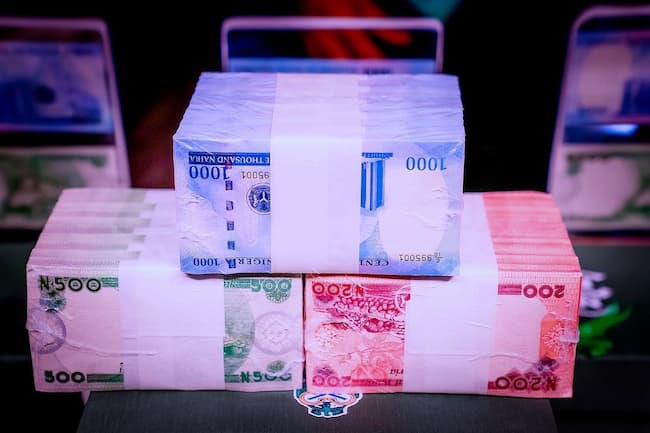
The Nigerian naira recorded further depreciation at the official foreign exchange market last week, even as the Central Bank of Nigeria (CBN) intervened by injecting $150 million through its FX auction mechanism.
Market data showed that sustained demand pressure continued to outweigh supply, pushing the local currency lower against the U.S. dollar despite ongoing interventions and inflows from foreign portfolio investors (FPIs).
During the week, the naira weakened by N10.09 at the official spot market, trading within a range of N1,450.00 to N1,469.90 per dollar. Currency traders attributed the movement to persistent dollar demand from importers and other market participants.
Despite the depreciation, FX dealers expressed cautious optimism about the medium-term outlook for the currency, citing structural reforms including the removal of exchange rate distortions and continued intervention by monetary authorities.
Meanwhile, Nigeria’s external reserves recorded a reversal in trend after maintaining an upward trajectory for nearly two months. Data released by the CBN showed that gross external reserves declined by $263.15 million during the week, falling to $45.21 billion.
The decline in reserves coincided with renewed uncertainty in the global oil market, which remains a critical source of foreign exchange earnings for Nigeria. Crude oil prices edged lower on a week-on-week basis, despite a late rally on Friday triggered by concerns over potential supply disruptions linked to a possible U.S. blockade of Venezuelan oil shipments.
Brent crude futures for February delivery settled at $59.47 per barrel, representing a weekly decline of 65 cents or 1.06 per cent. Similarly, West Texas Intermediate (WTI) crude closed at $55.52 per barrel, shedding 92 cents over the same period.
In contrast to oil’s performance, gold prices advanced during the week as investors sought safe-haven assets amid weakening U.S. consumer sentiment and heightened macroeconomic uncertainty. This occurred despite continued strength in the U.S. dollar and elevated Treasury yields.
Spot gold rose by 0.84 per cent to close at $4,338.55 per ounce. Market analysts project that gold may continue to receive support in the near term as investors navigate softer U.S. inflation data and cautious economic outlooks.
Looking ahead, analysts expect sentiment across financial markets to remain guarded. While gold is likely to benefit from safe-haven demand, oil prices may remain volatile or face downward pressure as concerns over global oversupply persist.










 intervened by injecting $150 million through its FX auction mechanism.)