








The Central Bank of Nigeria (CBN) has significantly reduced its net loan exposure, slashing lending by over N4.1 trillion in 2024 as part of a broader strategy to rein in fiscal imbalances and curtail its overdraft facility to the Federal Government.
As per the apex bank’s audited 2024 financial statement, net loans and receivables at the CBN level dropped from N16.122 trillion in 2023 to N11.977 trillion in 2024. On a consolidated basis, the group figure dipped from N15.091 trillion to N10.959 trillion—representing a N4.132 trillion contraction.
This dramatic reduction stems mainly from the decline in the CBN’s overdraft lending to the Federal Government, previously executed under the controversial Ways and Means provision. This legal framework, enabled by Section 38 of the CBN Act, 2007, allows the central bank to provide short-term advances capped at 5% of prior-year government revenue.
This limit was repeatedly exceeded in the past, sparking concerns over fiscal recklessness. In 2023, the National Assembly approved the securitisation of N22.7 trillion worth of these loans, converting them into long-term debt to relieve inflationary pressure and restore monetary stability.
In 2024, the overdraft facility shrank from N7.948 trillion to N3.268 trillion, marking a reduction of N4.679 trillion or 58.89%. This aligns with Governor Yemi Cardoso’s pledge to reverse years of fiscal dominance and reposition the bank’s operations under more orthodox monetary principles.
Consequently, CBN earnings from the Federal Government overdraft facility plummeted—from N1.6 trillion in 2023 to just N3.1 billion in 2024. However, the bank’s Standing Lending Facility surged to N386.904 billion, up from N29.431 billion a year earlier—indicating intensified activity in interbank liquidity management.
Long-term loan disbursements also climbed to N2.722 trillion in 2024 from N2.009 trillion in 2023, an increase of N712.673 billion, signaling continued support for select financing schemes.
Other financial instruments showed mixed performance. Asset Management Corporation of Nigeria (AMCON) Notes rose from N3.902 trillion to N4.136 trillion, while the “Other Loans” category saw a modest dip to N530.655 billion.
Meanwhile, staff loan balances increased at both the group and bank levels, reaching N65.644 billion and N65.194 billion respectively. Nigerian Treasury Bonds held steady at N423 million.
A notable development was the complete elimination of Promissory Notes, previously valued at N23.028 billion, and the NESI Stabilisation Strategy Limited Debenture, which fell from N802.918 billion to zero in 2024. NESI SS Ltd, a CBN-created Special Purpose Vehicle, was designed to resolve liquidity challenges in the Nigerian electricity market.
Total gross loans saw a sharp contraction, with group-level loans falling by N3.624 trillion to N12.767 trillion and bank-level loans down by N3.645 trillion to N13.778 trillion. Meanwhile, allowances for Expected Credit Losses (ECL) increased from N1.3 trillion to N1.801 trillion at the bank level, highlighting more stringent credit provisioning.
The CBN also intensified loan recoveries from its intervention finance schemes, recouping N252.996 billion at the bank level and N224.64 billion at the group level. Major repayment programmes included the Anchor Borrowers’ Programme (recovered N112.922 billion), the Commercial Agricultural Credit Scheme (recovered N43.33 billion), and the Real Sector Support Facility (recovered N37.507 billion).
Other schemes, like the BOI Debentures, Export Development Facility, and Non-Oil Export Facility, also recorded marginal repayments. However, the NIRSAL Lending Debenture slightly increased to N269.380 billion, remaining a significant line item.
Micro, Small and Medium Enterprise (MSME) loans declined modestly, while the NBET Payment Assurance Facility and the Nigerian Mortgage Refinance portfolio posted small drops. The Perpetual Debentures and Accelerated Agricultural Development Scheme balances dropped by N3.547 billion and N3.375 billion, respectively.
One of the largest clean-ups was the NESI SS Ltd loan facility, which fell from N802.918 billion to nil, while the NESI SS Ltd Loan decreased to N368.371 billion.
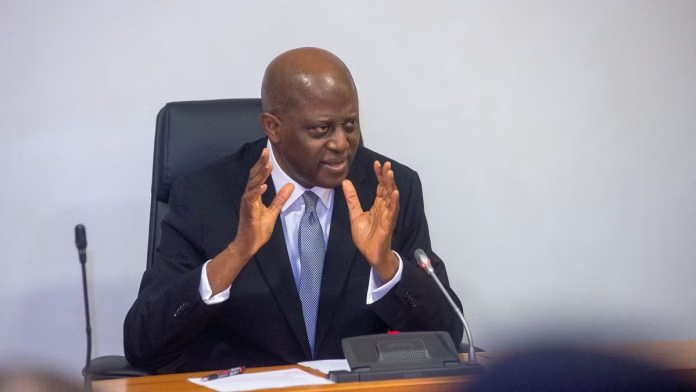
Governor Cardoso, speaking after the CBN’s first Monetary Policy Committee meeting of 2024, emphasized the bank’s departure from the interventionist strategies of the past. He described the former approach as distortionary and unsustainable, citing more than N10 trillion worth of poorly tracked intervention funds.
According to Cardoso, “There is no wiggle room to take up interventions that have a high likelihood of failure or fail to benefit intended recipients.”
The 2024 audited report underscores this strategic shift, showing significant loan recoveries, reduced central bank exposure to federal financing, and tighter credit controls.
While new intervention schemes have been suspended, the repayment and review of legacy programmes continue, with stakeholders offering mixed reviews. Advocates credit the schemes with supporting key sectors, while critics cite inefficiencies and inadequate oversight as reasons for their phase-out.









 has significantly reduced its net loan exposure, slashing lending by over N4.1 trillion in 2024 as....)