







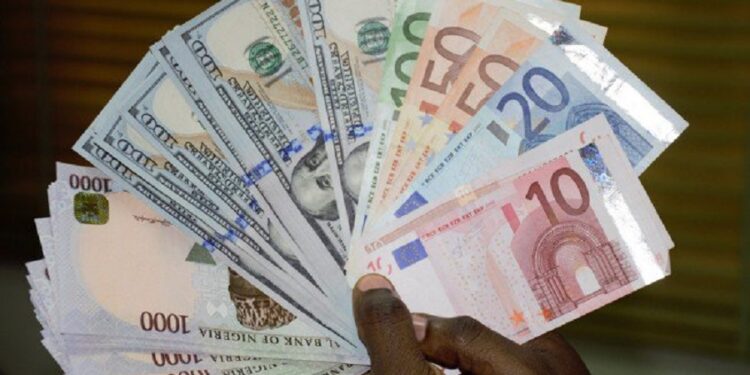
Nigeria’s foreign exchange market recorded a significant contraction in supply last week, with total U.S. dollar inflows dropping by more than 25% to $672 million, according to data from Coronation Merchant Bank Limited.
This marks the third consecutive weekly decline in November, reflecting mounting FX shortages at the official window. The dwindling inflows contributed to fresh depreciation of the naira, prompting the Central Bank of Nigeria (CBN) to inject $50 million into the market to support liquidity for authorised dealers and financial institutions.
The naira displayed mixed performance across FX segments during the week. At the official window, the currency slipped by 0.41% to close at N1,442.43/$1 from the previous N1,436.58/$1. In contrast, the parallel market strengthened by 1.03% to settle at N1,450/$1, narrowing the gap between both markets to 0.52%, down from 1.98%.
FX inflows into the Nigerian Foreign Exchange Market (NFEM) dropped to $672.30 million from $899.20 million the previous week, a sharp dip from the $1.37 billion peak recorded earlier in November.
Analysts attribute the slowdown in inflows to heavy selloffs of naira-denominated assets in the fixed-income market as investors reacted to the new capital gains tax measures. This led foreign investors to aggressively convert their holdings from naira to dollars, intensifying pressure on the currency.
Foreign portfolio investors (FPIs) remained the largest contributors to FX inflows, accounting for 34.42% ($231.40 million). They were followed by non-bank corporates (25.70%), exporters (22.47%), individuals (7.56%), and the CBN (5.52%), with other sources contributing 4.33%.
Nigeria’s external reserves rose slightly by 0.24% week-on-week (USD$103.06 million) to $43.43 billion as at 13 November 2025.
Amid global market developments, oil prices strengthened earlier in the week as renewed geopolitical concerns increased supply-risk premiums. U.S. sanctions on Russian crude, combined with Ukrainian drone strikes on major refineries, heightened fears of disruptions and boosted prices.
Market optimism over a potential resolution to the U.S. government shutdown also supported early gains; however, expectations of a sizable global crude surplus kept sentiment cautious.
Midweek, prices reversed after OPEC projected a supply-demand equilibrium by 2026—an adjustment from its earlier deficit forecast—while the International Energy Agency (IEA) released a bullish long-term demand outlook running to 2050.
Crude prices later stabilised following a sharp decline triggered by concerns over oversupply and larger-than-expected builds in U.S. crude inventories. Momentum was further restricted by weaker-than-anticipated draws in major refined products.
Despite the volatility, Brent crude ended the week slightly firmer as another Ukrainian drone strike temporarily halted exports at Russia’s Novorossiisk port.
The modest price rebound reduced Brent’s year-to-date decline to 14.32%, while the average annual price edged up to $68.88/bbl, still 13.75% lower than 2024 levels.