







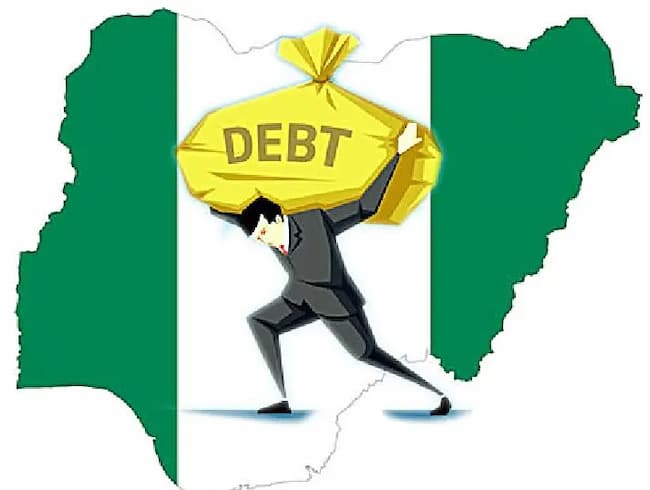
Nigeria’s domestic debt stock rose to ₦77.81 trillion as of September 2025, reflecting sustained borrowing activity by the Federal Government within the local debt market.
The latest data released by the Debt Management Office (DMO) shows that federal bonds remain the dominant instrument within the country’s domestic debt structure, accounting for approximately 80 percent of the total portfolio.
FGN Bonds stand at ₦61.9 trillion, with ₦60.64 trillion issued in naira-denominated instruments and ₦1.35 trillion in U.S. dollar-denominated bonds. Nigerian Treasury Bills represent ₦12.68 trillion, equivalent to 16.3 percent of the domestic debt stock.
Other instruments include Sukuk bonds valued at ₦1.29 trillion, FGN Savings Bonds at ₦97.46 billion (0.13 percent), and FGN Green Bonds at ₦62.36 billion (0.08 percent). Promissory Notes total ₦1.69 trillion, comprising ₦431.22 billion in naira-denominated notes and ₦1.25 trillion in foreign currency-denominated obligations.
Borrowing Strategy Reflects Mix of Long and Short-Term Instruments
The structure of Nigeria’s domestic debt highlights the Federal Government’s reliance on long-term bonds to secure stable funding while utilizing treasury bills to manage short-term liquidity requirements.
FGN Savings Bonds are designed to broaden retail investor participation, providing smaller investors with access to government securities. Green Bonds are allocated toward environmentally sustainable initiatives, including renewable energy and climate-related projects.
Sukuk bonds, structured in line with non-interest financing principles, are commonly used to fund infrastructure development. Promissory Notes are issued to convert verified legacy obligations — such as contractor arrears — into structured debt instruments.
Although specialized instruments represent a relatively small share of the total portfolio, their inclusion signals efforts to diversify funding channels and deepen market participation.
The Q3 2025 figures were released following scrutiny regarding delays in public debt data publication. Traditionally, such disclosures are made toward year-end, enabling analysts and investors to update financial models before the close of the fiscal year.
The updated data provides clarity on Nigeria’s domestic borrowing profile and offers investors and policymakers insight into the scale and composition of federal debt within the local market.